Body Image Issues Aren't Your Thorn —They're Something the Gospel Can Actually Cure [Podcast Transcript]
Sep 04, 2026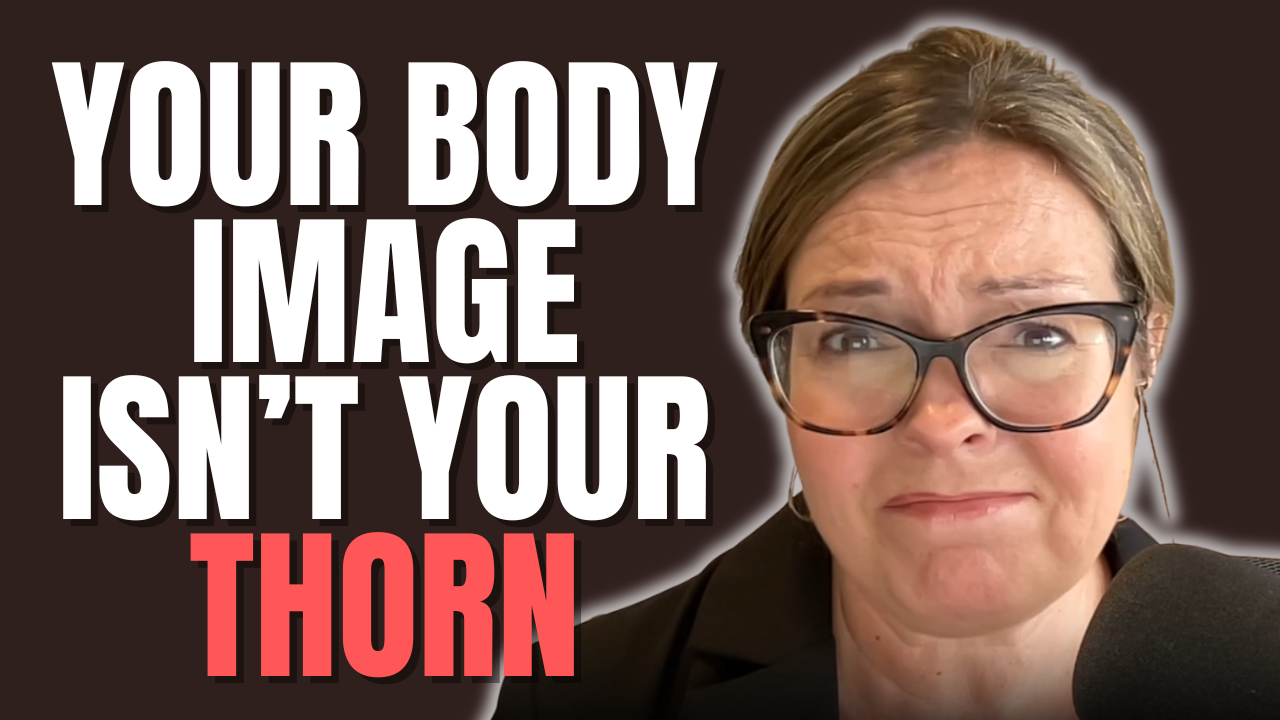
Title: Body Image Issues Aren't Your Thorn —They're Something the Gospel Can Actually Cure
Podcast Date: August 25, 2026
Listen Here:
Description
Have you heard it or said it? Maybe your body image issues are "your thorn in the flesh." It sounds comforting, but is it actually true? In this episode, we take a close look at what Paul's thorn in 2 Corinthians 12 actually was — and wasn't — and see how body image issues are different than the situation Paul discusses there. We'll also talk about how recognizing that your body image issues aren't your "thorn in the flesh" may be some of the most hopeful news you get, because then there's a cure for them. And, it's all found in scripture!
Key Scripture references:
- 2 Corinthians 12:7–10 (the thorn in the flesh)
- Colossians 3:5 ("greed, which is idolatry")
- Colossians 3:9–10 (put off the old self, put on the new)
- Romans 6:14 (sin shall not be your master)
- 1 John 1:9 (confession and cleansing)
- 2 Corinthians 5:17 (new creation)
Discussion questions for listeners / community:
- Have you ever described your body image struggle as "your thorn"? How did that framing shape whether you expected it to change?
- Try praying both prayers from this episode — the confession prayer and the contentment prayer. Which one actually named what's true for you?
- What would it look like this week to bring one specific piece of body-image idolatry into the light through honest confession?
Timestamped Guide to Episode
00:00 Exploring body image and faith
03:38 Addressing body image issues
09:41 Biblical thorns and grace
12:21 Idols in Modern Christian Culture
16:32 Understanding body image issues
19:00 Inviting women to join workshop
22:16 Admitting struggles and seeking help
27:39 Choosing the right prayer
28:45 Dealing with aging and grace
A note: This episode distinguishes disordered body worship (idolatry) from genuine physical affliction (illness, disability, medical conditions). Listeners walking through the latter should be pointed toward lament and grace, not confession — this episode is specifically addressing the worship-pattern many of us have around appearance and worth.
Links:
Heather's best-selling Christian books on body image, aging, and comparison: https://www.improvebodyimage.com/books-for-christian-women-body-image
Join us on the next 40-Day Journey in September. Learn more here: https://www.improvebodyimage.com/40-day-challenge
Transcript
Disclaimer: This transcript is AI-generated and has not been edited for accuracy or clarity.
Heather Creekmore [00:00:02]:
Life Audio. Hey there, friend! Heather Creekmore here. I'm so glad you're listening to the Compare To podcast today. Hey, we are back for another year of new episodes, and today we're starting with a hot topic. Oh y'all, I couldn't tell you how many times I have had someone say this to me. And it sounds like this: my body image issues are just my thorn in the flesh. Maybe you've heard it too. Maybe you've had a friend say it to you or a small group leader or a pastor.
Heather Creekmore [00:00:41]:
And perhaps you're sitting there exhausted, having confessed for the 100th time that you can't stop obsessing over your body or your weight or your size. What you look like, how you're aging, and someone just delivers you on a platter Paul's words from 2 Corinthians, thinking it's a warm blanket. Like, God's grace is sufficient for you. His power is made perfect in your weakness. What if the struggle is just your thorn in the flesh, just like Paul had? You just have this problem so you'll stay humble and continue to lean on God. And I understand sort of like how we get there. Um, and maybe it adds a little comfort, maybe it takes a little pressure off, maybe it tells us something like, this isn't your fault, or there's nothing you can do about it, just endure these body image issues and let God's grace cover them. But today I want to offer a different perspective.
Heather Creekmore [00:01:43]:
I want to gently And firmly push back that your body image struggle is not the same as Paul's thorn. And calling your body image issues that, as I don't know, maybe generous or kind as it sounds, if you categorize your body image issues as your thorn in the flesh, you might actually be keeping yourself stuck in a struggle. That the gospel already has an answer for. Because if the root of your body image issue is what scripture and thoughtful teachers, and honestly, maybe your own gut have been telling you, that it's sin, idolatry, disordered worship, then that is categorically different than Paul's thorn in the flesh. A thorn is something you are called to endure. Sin is something you're invited to bring to the cross. And those are not the same thing. That's where we're going today.
Heather Creekmore [00:02:44]:
I'm glad you're here for it. Let's get going. Hey friend, today we are gonna go deep. We're going to look at some theological things that I hope are going to help you. I hope this distinction that your body image issues are not your thorn in the flesh Will be one of the most freeing things that you've ever heard. So today we're going to look at what was Paul's thorn in the flesh actually, what wasn't it, and why maybe so many of us have borrowed that language to describe something that the Bible actually categorizes as very different. And here's the hope buried in all of this. I don't want you to lose this as we go deeper into the theology.
Heather Creekmore [00:03:38]:
If body image issues have a root of sin, that means they also have a cure. When I would do speaking engagements early on, I would carry this bag and I would talk about, oh, being a woman, I just had to carry on this bag of my issues, this bag of my body image issues. Oh, what a burden it was to have this bag of my body image issues. And then I would talk about how, no, if there was a root of sin, then this wasn't some baggage I just had to drag around with me, that there was actually a cure for it. And I would throw the bag across the room, kind of surprise the people in the audience and try not to hit any of them, but just to show how different it is once you see the root of these issues. You can also see that there's a cure. But here's the thing, thorns don't have a cure. Paul asked 3 times and God said no, they don't.
Heather Creekmore [00:04:44]:
I mean, maybe they have a cure, but they don't get cured. Or at least God did not cure Paul's thorn. But sin? Oh, friends, sin has a Savior. Sin has a cross. Sin has a therefore now there is no condemnation. From Romans, to categorize it as something different. It's a completely different trajectory than learn to live with this forever and God's grace is sufficient. Okay, so let's start by looking at what Paul's thorn actually was.
Heather Creekmore [00:05:22]:
So let's look at the passage, 2 Corinthians chapter 12. Paul's just described being caught up into paradise, an extraordinary spiritual experience. He's had visions, revelations, all the things. And right after describing this, he says that to keep him from being conceited— and why would he be conceited? Well, because he's just had these amazing, great revelations. Like he's, you know, a superhero in the faith, seeing these amazing revelations from God. So to keep him from being conceited, he was given a thorn in the flesh. And then here's what else it says about that thorn. A thorn in the flesh, a messenger of sin.
Heather Creekmore [00:06:03]:
Satan to torment him. He pleaded with the Lord 3 times that it would leave him, and the answer he got back wasn't, I will help you overcome this, Paul. It was instead, my grace is sufficient for you, for my power is made perfect in weakness. Now, Bible scholars have debated for centuries exactly what Paul's thorn was. Some think maybe it was a physical ailment like eye trouble or some sort of recurring illness. Some think it was a specific person or group of opponents who tormented him wherever he went. Some connect it to temptations of the flesh in a more general sense. But the honest answer is we really don't precisely know exactly what it was.
Heather Creekmore [00:06:52]:
And even the most serious commentators think that ambiguity is probably intentional so that believers in every generation could see their own affliction reflected in Paul's words. But here's what we do know clearly from the text, and this part's not ambiguous at all. Okay, first, we know that the thorn was given by God through a messenger of Satan. Well, that's kind of yikes. We need to probably break that down for a second. But it's for a specific purpose: to keep Paul from pride after an extraordinary spiritual high. It wasn't punishment for something Paul did wrong, and it wasn't rooted in a sin That Paul needed to repent of. This was God permitting Satan to afflict Paul with something that would be used for his sanctification.
Heather Creekmore [00:07:52]:
God allowed this hard, bad thing to be used to keep Paul humble. Now I know you're thinking, but Heather, maybe God's allowing my body image issues to be used to keep me humble. But friend, hear me, this wasn't rooted in sin. There is nothing Paul needed to repent of here. Okay. Number 2, Paul asked for it to be removed and God said no, not, not yet, not keep working on it. It was a clear no, but it's paired with a promise. And the promise is, my grace is enough.
Heather Creekmore [00:08:30]:
My power shows up best when you are weak. And some of you're like, again, Heather, you're talking about my body image issues. I have prayed and I've asked God to have them removed way more than 3 times, and God's not doing anything. I'm still struggling. Right. But, but hear me, friend. God would never say his grace is enough. For a situation where you are stuck in sin, that requires repentance and confession.
Heather Creekmore [00:09:02]:
And if you're still not sure that that wasn't the response, number 3 here, Paul's response was acceptance. If Paul had a sin issue to deal with, his response would have been repentance. But instead, Paul says, I will boast all the more gladly about my weaknesses so that Christ's power may rest on me. He didn't confess. He didn't put the sin to death. There's no sin here. He's learned to be content in this affliction, whatever it is, and he's learned to even see purpose in it. He knows it's trying to keep him humble.
Heather Creekmore [00:09:41]:
That's the whole shape of what a thorn is in the biblical sense. It's an affliction permitted by God, and you've begged God to remove it. But it's not being removed. And so you have to learn to carry it with contentment because God's grace proves sufficient in the carrying. Okay, so hold on to that shape, hold on to those definitions, because we're about to compare it to something very different right after this quick break. Okay, now let's take a look at what scripture actually says, talks about sin. And specifically, this is sin That I talk about a lot on this podcast. If this is a brand new concept for you, if you're new to the show, I talk about idolatry because I have found personally my story.
Heather Creekmore [00:10:33]:
I share it in my book Compared to Who, uh, through my body image workbook. I talk about this, but idolatry, friend, is what I see over and over and over again. It's the sin that is keeping women and probably men too stuck. with body image issues. So when we're honest about kind of the mechanics of what's going on, what's behind our body image issues, that's normally what we find. So let me just break this down for you. Idolatry in the simplest sense is taking something good, even something just genuinely good, a good gift from God, and turning it into something more. So it could be like caring for your body or wanting to be healthy or wanting to feel confident or wanting to feel loved.
Heather Creekmore [00:11:23]:
Those are good desires. It could even be a desire to lose weight. That's not a bad desire. But what happens in idolatry is instead of looking for really what God can only give, like security and worth and identity and peace and salvation, instead of seeking those things from God, we seek them from something else, something that can't deliver. And in the case Of body image idolatry, we are seeking that security, worth, identity, peace, rest, salvation. We're seeking that from the way our body looks or the way our body feels, or the number we see on the scale, or the reflection we see in the mirror, or that size tag in our clothes. We are asking something that can't deliver God's promises. to try to deliver on God's promises, and we are therefore making it an idol.
Heather Creekmore [00:12:21]:
The tricky thing about living in the United States in this day and age is, especially in Christian culture, we tend to think we don't have any idols because we don't have any statues, right? We're not physically bowing down and worshiping something. But what God looks at, right, is our heart. And we can tell what our heart is worshiping by where we give our time and attention, what we spend all of our time thinking about, what we spend all of our money on, what consumes us. And when we are consumed by something like body image issues, like changing the number on the scale, it can become an idol because we start to believe that changing the number on the scale will save us. Now, okay, it's not salvation. Like, we don't believe getting a lower number on the scale is going to send us to heaven. Of course not. But we do kind of believe getting a lower number on the scale might send us to some sort of earthly version of heaven, right? We might be able to live heaven on earth if we can live here in a size 4 instead of a size 14.
Heather Creekmore [00:13:34]:
And wow, that lie, that promise is so subtle, but it's So convincing, and it's so lucrative, and it's so, again, subtle, right? Because it seems like a good desire. And that's the tricky thing about idols. Often it's good desires that become inordinate desires, desires that replace our true Savior, our true hero, our true God with little-g gods making promises they can't deliver on. So Colossians chapter 3 names this outright. Paul calls greed idolatry, and it's not greed is like idolatry, it's greed is idolatry because the mechanism is the same. We take a desire and we elevate that desire to the seat that should belong only to God. And that's the exact mechanism at work when our worth rises and falls with the number on the scale. Or when a bad glance in the mirror can ruin your whole day.
Heather Creekmore [00:14:42]:
Maybe when you'd rather skip the pool party than be seen in a swimsuit. When your mood, your confidence, your sense of being okay is completely tethered to how your body looks or how your body performs, it's not just vanity. It's worship that is misdirected. It's worship pointed at your body and your appearance rather than the place it belongs, on the Lord. And here's why this matters so much. Scripture never tells you to ask God to help you carry your idolatry with contentment. You hear what I'm saying there? Right? The Bible doesn't say, keep your idolatry, just ask God to help you be content with your idolatry, right? Like nobody in the New Testament says, 3 times I pleaded with the Lord to remove my greed And he said, no. So I've learned to be content in my greed.
Heather Creekmore [00:15:37]:
Like, that would be absurd because greed isn't a thorn in the flesh. It's sin. And sin isn't managed. We put sin to death. Paul says it so plainly in Colossians, put to death whatever belongs to your earthly nature. In Ephesians, he talks about putting off the old self and putting on the new. In Romans 6, he says, sin shall no longer be your master because you are not under the law, but under grace. It's not, sin will always have some mastery over you and you'll just have to endure it.
Heather Creekmore [00:16:05]:
But genuinely, it says it will no longer be your master. Then in 1 John, we get maybe the clearest promise of all. I love this verse, 1 John 1:9. If we confess our sins, he is faithful and just to forgive us our sins and to cleanse us from all unrighteousness. Cleanse. Picture soapy, sudsy water, rinsed clean. Not help you cope with. Cleanse.
Heather Creekmore [00:16:32]:
Do you see the difference? A thorn gets a, no, my grace is sufficient for you. Sin gets a, yes, confess it and I will cleanse you. Those are 2 completely different promises for 2 completely different problems. Okay, here's why this matters so much. First, Calling your body image issues a thorn quietly lets you off the hook from doing the one thing that can actually lead to freedom, and that's confession. You see, if I believe my obsession with my body is just a thorn, it's an affliction, God's permitted it, ah, it's not going to remove it, my job is to just endure it, I pray for grace to carry it— some of you are taking thoughts captive and just praying for grace to keep enduring it. You know, maybe you'll even find in there some sort of strange spiritual pride for how long you've suffered with these issues and how long you've carried these issues and how long you've been afflicted with this thorn. But friend, if it's actually idolatry, your job is not endurance.
Heather Creekmore [00:17:41]:
It's confession. It's naming honestly before God, I have been asking my body to be my savior. I have trusted my appearance to give me, Lord, what only you can give me, that rest. That hope, that peace, that joy. But instead of asking and believing all those things come from you, I have made an idol here. And that's a completely different posture, but it's the posture that scripture says leads to actual cleansing, not just management. I wrote a book called the 40-Day Body Image Workbook a few years ago. It's called 40-Day Body Image Workbook: Help for Christian Women Who've Tried Everything.
Heather Creekmore [00:18:22]:
And the reason I wrote this book is because I kept meeting over and over again, Christian women who tried everything but confession. It never even occurred to them that they could have a body image idol. And what we do, we do a 40-day journey. I'd love for you to join us. We started again in September. It's 40 days of walking through my body image workbook in group Zoom calls. You get to ask questions, you get to engage with other women who are struggling with the same things. But what we do is we dig into the heart of this idolatry and expose it for what it is.
Heather Creekmore [00:19:00]:
And over and over again, every time we do this 4 times a year, every time we run these groups, it's just amazing to watch women have kind of the light bulb moment where it's like all of a sudden like, oh, I see it now. I didn't see it before, but oh, I see it now. So if you're hearing this and you're like, I don't see it. Maybe. I don't know. I would really invite you to join us on the next 40-day journey that starts September 14th. Grab the workbook and just be ready to, to dig in with us. You can learn more about it on my website, improvebodyimage.com.
Heather Creekmore [00:19:33]:
Doesn't matter how old you are. We've had women almost 80. We've had women as young as 16 on there. Just be a part of that and let us be a community for you to help you find This root and confess it and start to take a new path forward out of these body image issues. But we were talking about why this is so dangerous to confuse the thorn with the sin of idolatry. And here's the second reason. If you continue to call your body image issues a thorn, you're going to be robbed of hope. Paul's thorn never went away.
Heather Creekmore [00:20:10]:
He asked 3 times. The answer was no, permanently for the rest of his life, as far as we know. And so if you filed your body image struggle under, this is my personal thorn, then you have functionally told yourself, this will never change. I'm stuck with this forever. The best I can hope for is grace to survive it, grace to endure it. Oh, friend. And then aging is gonna come and continue, right? Or you'll face some sort of sickness or disease that changes your body. Mm-hmm.
Heather Creekmore [00:20:42]:
And it's gonna feel hopeless because if you've just told yourself, I'm just always gonna hate what I look like, I'm just always gonna feel bad in my body, this is always gonna be an area of struggle for me because this is my thorn and I have low self-confidence, and oh, woe is me, you turn into Eeyore, I'm just gonna have to struggle. Oh friend, you're missing out on scripture's promise. The promise to help you defeat sin. Well, actually, you don't have to defeat it. Jesus defeated sin. You just get to receive what he did on your behalf. Idols get torn down. Hearts get genuinely, progressively freed.
Heather Creekmore [00:21:29]:
Not when we get to heaven. Now, here, this side of heaven. Friend, you are not sentenced to a lifetime of body obsession. The way Paul was probably sentenced to a lifetime of some sort of physical ailment. That is not the category you are in if you have body image issues. Third, and this one's really important, mislabeling your body image issues as a thorn actually makes you less humble, not more humble. The whole purpose of Paul's thorn was to protect him from pride. But if you are using the, it's just my thorn in the flesh, to avoid the humbling work of confession, then you've actually inverted the purpose.
Heather Creekmore [00:22:16]:
True humility here isn't stoically enduring a struggle that you've decided is permanent. True humility is admitting out loud to God, maybe even to a trusted friend, maybe in one of our groups, To a community that is safe in talking about these issues, you say, I built an altar on my appearance and I need to tear it down. Oh friend, that is a harder kind of humility than the quiet endurance of my cross to bear. I'm a martyr. This is just my issue. It'll never go away. Oh friend, but if you can find the humility to confess, to repent, That's going to actually lead you somewhere. And I'd really, I want you to hear this with so much grace because this isn't me saying your struggle isn't real or you're a bad Christian for having body image issues.
Heather Creekmore [00:23:13]:
Friend, I walked it for decades of my life. I'm also not going to tell you that confessing it means it's instantly gone forever and you're going to wake up tomorrow morning and you're not going to struggle anymore. That's not true. Sanctification is a process. Idols get toppled, but sometimes we have to make a practice of toppling the idol every single morning because overnight our hearts can rebuild them again. And that's just normal. That's just the Christian life. That is how we grow, right? We are going to be tempted to follow those idols again.
Heather Creekmore [00:23:49]:
Goodness, spend 5 minutes on social media and you are going to be tempted to follow those idols again. And that's why you need support. It's not just confess, repent, wake up tomorrow and never struggle again. You need community and some tools and a framework and some support and maybe a coach. You need some assistance in walking this out to freedom. But every single time, the invitation is for confession that leads to freedom. It's not toward permanent resignation. Woe is me, this is my cross to bear.
Heather Creekmore [00:24:40]:
So let's make this super practical, because I know some of you might be thinking like, okay, I hear you, Heather, maybe my body image issues aren't my thorn in the flesh, but I would really like Just some sort of diagnostic quiz. I'd like to know, how do I tell the difference then between a thorn in the flesh and something that maybe I need to confess? Maybe an idolatry problem like we talked about. So here's a few questions you can honestly ask yourself. Okay. Question 1, does this thing demand worship or does it simply hurt? A thorn is painful, but it doesn't ask anything of you. Like some have said, maybe Paul's affliction, his thorn, was eye problems. So I don't know, I'm— I think I'm farsighted. No, maybe I'm nearsighted.
Heather Creekmore [00:25:25]:
I don't know. I can't see anything without some contact lenses or glasses, right? But I have never once thought about worshiping my poor low vision, right? It doesn't demand my devotion. It doesn't demand my time. It doesn't demand my attention or tribute. An idol does. And if your body image struggle has you constantly body checking, feeling your stomach, checking mirrors, anything reflective as you walk by it, if you're constantly calculating, constantly rearranging your day around how you look or what you've eaten or how much more you need to exercise to burn off what you've eaten, Or friend, if seeing a number on the scale can ruin your whole day and determine your mood and make it harder for you to love people, that's not the same as a painful thorn. That's self-inflicted pain. That's a body and a body image that's demanding worship and attention and causing you pain.
Heather Creekmore [00:26:35]:
Because of what it demands, not because of inherently what it is. Okay. Second question to ask yourself, does it promise rescue? You see, thorns don't promise anything, right? If you had eye disease, if you had glaucoma or macular degeneration, it doesn't promise you anything, right? A disease doesn't promise you anything. An affliction to humble you doesn't promise you anything. You just endure it. You lean on God's grace. But idols always promise something, and that's where it takes some careful listening, saying, what do I really believe I'm gonna get if I do this or change this or pursue this? Idols whisper, if you get this right, you'll feel secure, you'll be loved, then you'll be enough. So if some quiet part of you believes fixing your body will fix your deepest ache, that's the signature of an idol, not a thorn.
Heather Creekmore [00:27:39]:
Third question: is confession the right response, or is contentment the right response? This is the clearest test of all. Try praying both prayers and see which one fits, actually, right? Pray, Lord, I confess that I've made my body an idol. I've asked it to give me identity and security and rest and peace that come from you alone. And then pray, Lord, help me be content in carrying this specific pain the way Paul was content carrying his. For most of us, when we're honest, the first prayer is the one that actually names what is happening. The second prayer for most body image issues is gonna feel like it's letting us off the hook a little too easy. Now, here's a very important caveat, because I don't want this to get twisted into something harmful. There are real physical experiences of the body— chronic illness, disability, disfigurement from an accident or medical condition, maybe even the ordinary changes of aging— that are genuinely more like a thorn than an idol.
Heather Creekmore [00:28:45]:
Those are afflictions that perhaps we do need to grieve and just carry with God's grace. They might not be sins to confess. In fact, in most of those cases, they probably aren't. Aging's a little on the line there because aging has— or anti-aging, I guess I should say— has become kind of the newest realm of, uh, body fixing, if you will, right? We're marketed to heavily around how to avoid aging so that we can keep a certain image. And that does become idolatry because it promises a lot of things. So again, knowing which you're actually dealing with in the case of aging is important. And so maybe your prayer does need to be just, let me be content with this. Or maybe it needs to be a little of both.
Heather Creekmore [00:29:33]:
God, oh man, the fact that I'm aging is causing me to look for hope and salvation from anti-aging tools instead of from you. I don't know. You, you've got to decide that with the Lord for yourself. I'm not saying that every bad or hard feeling you have about your body is idolatry. In fact, in the 40-day journey, we go into grief because part of accepting your body— and I don't— when I say acceptance, I don't mean resignation. I don't mean like, well, I guess this is it. I'm going to sit on the couch and eat Cheetos because This is what my body looks like. I don't mean that.
Heather Creekmore [00:30:14]:
That's black and white thinking. But part of coming to a place where you're like, this is the body God gave me, I'm gonna steward it well. He created me on purpose for his purpose. He has things for me to do. Part of that whole package is grief, where you are wrestling with what I call your ideals, which are actually always your idols. You're wrestling those idols. And saying, yeah, but I really thought it was going to look like this. I really thought I was going to age like this.
Heather Creekmore [00:30:40]:
I really thought I was going to be a mom who looked like this. I really thought I was going to be a professional woman aged 45 who looked like this. I really thought I was going to be a grandma who looked like this. And none of those ideals look like I thought they would look. And this hurts and this is painful and I don't know what to do with it. It's normal to have hard feelings about your body from time to time. That doesn't mean that's idolatry. But here we're talking about specifically naming a pattern where worth, security, peace, rest have become tethered to your appearance.
Heather Creekmore [00:31:20]:
And the struggle isn't really about the body itself, but it's about what's going on on the inside. It's about what you're demanding the body to deliver. That's the pattern with a cure. So let's find some hope as we wrap this up today. Friend, if your body image struggle has a root of idolatry, like, I think this is the best news ever, right? Because we can tear idols down. We know a God who topples idols and he doesn't leave rubble there. He rebuilds. 2 Corinthians 5, just a few chapters before the thorn passage, it says that if anyone is a new creation in Christ, the old is gone, the new is here.
Heather Creekmore [00:32:00]:
That's not the language of permanent affliction. That's the language of genuine ongoing transformation. Friend, your cure is not a better diet, a better exercise program, more willpower, trying to Jedi mind trick your way into being content with the struggle that you've decided is permanent. The cure is the same cure that we've always had for all Confess, repent, allow the ongoing work of the Holy Spirit in your life to replace the false sense of where you're trying to derive worth with the true one. It's slow. Oh friend, it is so messy. You need support on the journey. That's why we do the 40-Day Body Image Journey.
Heather Creekmore [00:32:51]:
But really, this is it. You are not carrying a thorn that God has permanently refused to remove. You do not have to just say his grace is sufficient and live with your body image issues. You're probably carrying an idol that Christ has already defeated on the cross and is patiently, faithfully waiting to help you tear down brick by brick in real time. It's not a life sentence. It's a rescue in progress. So here's what I hope you walk away with today. Please stop calling your body image issues your thorn.
Heather Creekmore [00:33:29]:
It's not doing you any favors, and it's actually not what scripture is describing. Call it what it is. It's disordered worship. It's a heart that's been asking your body to be your savior. And then do what scripture actually invites you to do. Bring it into the light, confess it, Be cleansed. Expect a change because that is exactly what the gospel promises for sin. Friend, if this episode challenged you or challenged maybe something you've believed for a while, I'd love to hear about it.
Heather Creekmore [00:33:59]:
And I'd love for you to share it with someone else who maybe has quietly resigned herself to the same struggle. She doesn't have to stay stuck and neither do you. Until next time, friend, you're not sentenced. You are being set free. Hey, I'm glad you listened today. I hope you are too. If this show blessed you, would you leave us a review? Your 5-star reviews help other listeners find the show. And we're excited about the season ahead, but most of all, we want to partner with you and help you find real freedom from your body image issues.
Heather Creekmore [00:34:35]:
So maybe this is the first time you've ever heard about body image idolatry Or maybe you're like, I'm ready. I am tired of living with this. I thought maybe I had to live with it because it was my thorn. Now I know I can be set free. How do I start? You start with the 40-day body image journey. It starts September 14th, Monday evenings. We want to see you there. It's super affordable, friend.
Heather Creekmore [00:34:55]:
Find out all about it at the body image journey tab on my website, improvebodyimage.com. Hey, I'm glad you listened today. I hope something today helped you stop comparing And start living. Bye-bye.
Tired of fighting your body image issues alone? Do you know that you're "fearfully and wonderfully made," yet still feel like your body isn't good enough?
Sign up here for weekly encouragement and take the 5-Day Body Image Challenge!