Is Your Food Plan a Religion? How Optavia & Weigh Down Workshop Promote the Religion of Worshipping Good Bodies [Podcast Transcript]
Jun 03, 2026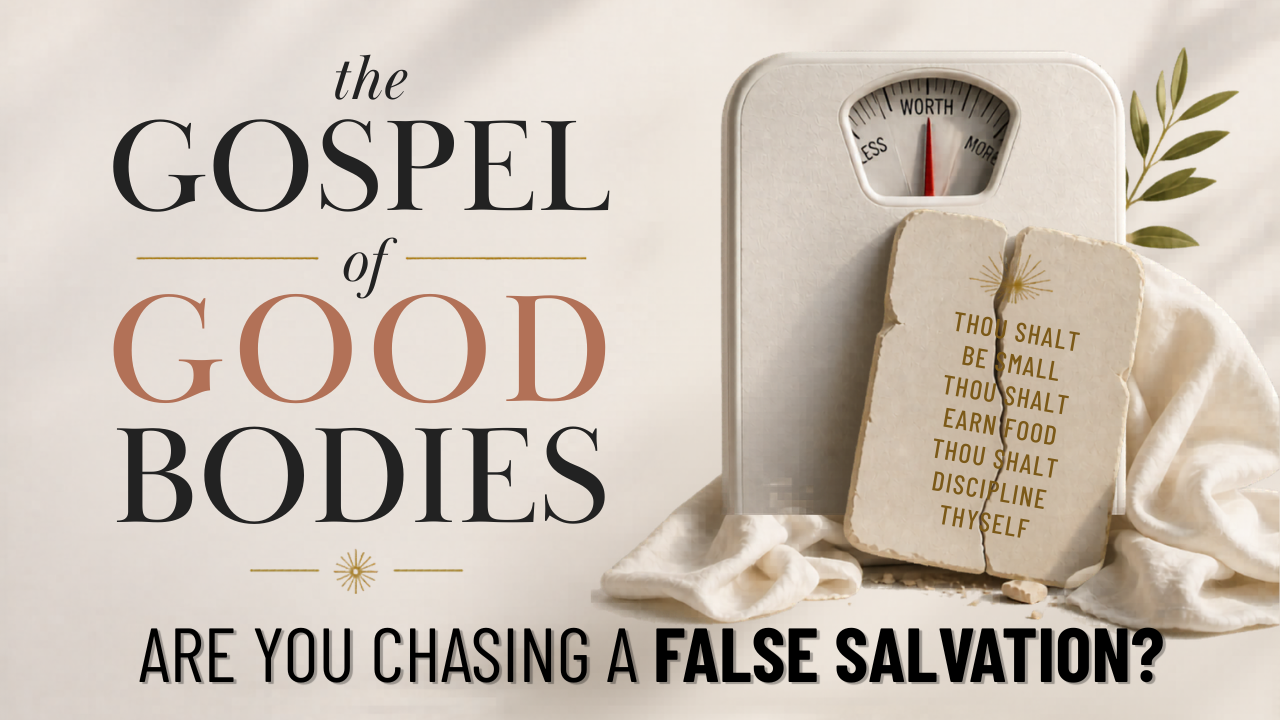
Title: Is Your Food Plan a Religion? How Optavia & Weigh Down Workshop Promote the Religion of Worshipping Good Bodies
Podcast Date: May 12, 2026
Listen Here:
Description
Are you curious about how diet programs sneak religious language into their sales pitch? Ever wondered why joining a weight loss plan at church can feel surprisingly similar to joining a church itself? On today’s episode, Heather Creekmore continues her powerful series, "The Gospel of Good Bodies," and exposes the insidious ways that popular diet programs like Optavia and the old Weigh Down Workshop blur the line between faith and food.
Heather Creekmore digs deep into:
- How diet culture borrows the architecture of salvation: Learn how programs diagnose a “fallen state,” promise transformation, offer coaching “saviors,” and tout communities that eerily resemble church groups.
- Shocking religious-sounding language from Optavia: Hear actual letters written to "brothers and sisters in Christ," urging members to “kick sugar in the face” as if it’s a spiritual battle; one equal to a believer's battle with pride!
- The tragic path of Weigh Down Workshop: How Gwen Shamblin’s transformative biblical dieting program morphed into a bona fide cult—with spiritual harm to match.
- Dangers of mixing body goals with spiritual worth: Why these messages distract from the true gospel and what Scripture actually says about food and the body.
- A word of hope if you feel trapped by religious diet culture: Heather Creekmore encourages you—there’s a better, grace-filled way to see your body through Jesus.
If you’ve ever joined a diet program because “a Christian was leading it,” or if you just want to protect your faith from diet hype, you can’t miss this episode!
Love this episode?
Check out other deep-dives with Heather Creekmore into:
- The Biggest Loser and its impact on our view of salvation
- Past episodes about what the Bible actually says about food and dieting
- The Weigh Down Workshop documentaries on Netflix and HBO Max
- Plus, Heather Creekmore references insightful books like David Zahl's Seculosity.
- Check out Heather's 40-Day Body Image Workbook or join us on the 40-Day Journey.
Let’s uncover the truth—together. Press play now!
Subscribe & Share:
If this episode helps you, share it with a friend and check out our other episodes on faith, body image, and the gospel of good bodies.
Next up: Why do we expect our clothes to forgive us? Don’t miss the next thought-provoking discussion!
Transcript
Disclaimer: This transcript is AI-generated and has not been edited for accuracy or clarity.
Heather Creekmore [00:00:02]:
Life Audio. Hey, friend, Heather Creekmore here. You're listening to the Compare to youo podcast. I'm glad you're here. We are continuing a series that I'm calling the Gospel of Good Bodies. We're, we're looking at the ways religious language and even maybe some Christian principles have snuck into the ways we relate to food, our bodies, eat, even fashion. Today we are talking about how diet programs became salvation movements. Oh, yikes.
Heather Creekmore [00:00:34]:
That sounds a little severe, but maybe you've been there, you're looking to drop a couple pounds, you're looking for a good way to do that. And there's a program at your church or there's a program that someone at your church is representing and she's a Christian, they're Christians. It's got to have God's rubber stamp on it. If a Christian is doing it, wouldn't that be the safe program to join? Wouldn't that be the best program to be part of? A program that aligns with your values as a believer? Friend, of course I jump on that too. But today we're going to have to dig in to the slightly uncomfortable, awkward, perhaps insidious ways these programs may have distracted, fooled, conned us into believing that God had rubber stamped them without God having done such a thing. We talked in the last episode about what the Bible actually says around food. And so a lot of these rules and programs have added things to scripture and then made it sound like it was just as important as following the Bible to follow their plan. But they've also showed us a fake definition of salvation, right? That salvation is attained when you change your body.
Heather Creekmore [00:02:04]:
And that's where it all gets really confusing. So I'm glad you're here today. Let's break it down. We're going to look at Optavia, we're going to look at the Way Down Workshop. We're going to talk about a few others. Let's go. So what if I told you there's a program with a trained guide who will walk alongside you on your journey? You can be with a community of fellow travelers, all believers. You can have a moment of transformation where you can cross over.
Heather Creekmore [00:02:41]:
You have a promise of becoming your optimal self. Is that a church or is that a diet plan? Well, turns out functionally it could be either. But what happens when a diet program just drops the functionality and straight up becomes a church? Well, that's what happened with the Way Down Workshop and Gwen Shamplin. I've done a couple other episodes on this. I'll link those in the show Notes, you can go check them out. But today we're going to talk about what happened with Way down, and we're also going to talk about a sneakier program that's much more popular now. I think Way Down's pretty much out of vogue. We're going to talk about Optavia.
Heather Creekmore [00:03:30]:
Last time we established that everyday food language borrows from our biblical vocabulary. But today we're going to go deeper. What happens when it's not just the language, it's a whole institution that is built a diet program, or in the case of Way down, it went from a workshop program to an actual church. What happens when an institution builds that language into its system and really makes the religion of weight loss and dieting into an actual religion? So two case studies. Like I said, we're going to look at Optavia. It's a program that sounds religious. I don't know that it intends to be, but I think it's pretty sneaky the way it's worked through church, churches and Christian women. And I think that religious language makes it sneakier.
Heather Creekmore [00:04:23]:
And then the Way Down Workshop was a program that intended to be religious and went all the way, but together they bracket the phenomena and how this happens perfectly. My thesis for this episode is this Diet, culture and salvation religion, they share the same architecture. Follow me. Here you are in a fallen state, right? As Romans would say, all have sinned and fallen short of the glory of God, right? And so what you need is rescue. You need a mediating authority. You need someone to save you. And then you need a path of transformation after that moment of salvation, right? So you can stay on the right path. And as you're on that path of transformation, it's helpful to have a community of others who have also been redeemed so you can be chasing the same same vision together.
Heather Creekmore [00:05:19]:
And although some of you heard that and you're like, of course, like, that's my salvation story, right? I was lost. I found Jesus. Now I'm found. I'm part of a church. I'm part of a great community. But isn't it a little weird how being a part of some diet programs gives us the exact same structure? I used to talk about it as the Biggest Loser definition of salvation. If you ever watch the Biggest Loser show, and I did an episode on the new document Henry on the Biggest Loser as well. But you see this play out, right, that people are in hell.
Heather Creekmore [00:05:53]:
They are in pain from their body size. They hate where they're at physically. They are in a fallen state. They go to The Biggest Loser ranch. They meet Bob or Jillian, and there are other coaches after that who really give them the power to change. They save them. They rescue them from their fallen state, and then they put them on a path to transformation. And they've got other contestants there along with them.
Heather Creekmore [00:06:23]:
So they have this community of people who are all trying to live a right life according to Bob and Jillian's rules, so they can achieve what is the ultimate. And I normally mockingly say wearing cute clothes and running marathons, but. But the ultimate is some vision of health, a vision of thinness, a vision of a different body size. And it sure does sound a whole lot like salvation. Right? So let's look at how this is and how this happens. We'll start with Optavia. Oh, Optavia. Now, first, hear me clearly.
Heather Creekmore [00:07:04]:
If you are on Optavia, if you are coaching Optavia, this does not mean that you are running a cult, leading a cult, that you are in any way bad for being part of this. Please don't hear what I'm not saying. I think I said that right. I'm not saying that. I have dear friends that have gone through the Optavia program. I have women that I have coached who have come out of an Optavia background and were actually quite successful in Optavia financially. My purpose here today is not to condemn or shame anyone who's been a part of Optavia. My purpose is just to reveal to you hidden danger of the way that diet programs may present themselves as an alternate religion.
Heather Creekmore [00:07:54]:
And with Optavia, we can see really clearly what I just explained about, you know, the biggest loser definition of salvation. Like, in order to need a savior, you have to be in a fallen state. Right. And Optavia does a beautiful job of telling people that they are not yet their optimal self. They're living in a sub optimal state. So in Christianity, that suboptimal state is sin and separation from God. Right? That's like the beginning of why you need salvation. That's the diagnosis of the human problem.
Heather Creekmore [00:08:29]:
But in Optavia, your problem is you've got too much fat, your body fat percentage is too high. You are not your optimal self. And the language of optimal is doing enormous work here. It implies that there is a version of you that is hear this. Not just better, but there's a version of you that is correct. Your current self is a deviation from that. You are not right. You've got a problem.
Heather Creekmore [00:08:59]:
And structurally, this is identical to the doctrine of the Fall. Optavia also wants you to explore the concept of your why you must identify your Deep motivation. And this functions like conviction of sin in an evangelical framework. You must feel the weight of where you were. Before you can begin the journey, you have to know your why. And oh, it sounds so innocent. And yet does it keep my focus on me and what I want for my life versus being sold out for Jesus and what he wants from my life? Oh, friend. And then there's the before photo.
Heather Creekmore [00:09:45]:
Okay. This is a cultural artifact. The before photo documents your fallen state. It is evidence of where you were. It is something to be left behind. It is occasionally retrieved and posted on Instagram to demonstrate the far distance of your sanctification that you have traveled. This is your testimony. This is your I once was lost, but now I am found.
Heather Creekmore [00:10:15]:
This is your evidence of Optavia saving you. And it should scare us a little bit that we don't even notice. David Zoll, I quoted in the last episode. He's written a couple great books, but one of them is called Seculocity. And Zoll notes that secular salvation movements always begin with a diagnosis, you are not enough. And that generates the anxiety that the program promises to resolve. And let me just be clear here, the program doesn't just promise to resolve it, right? You pay to have it resolved. The program is selling you something.
Heather Creekmore [00:11:00]:
So the program is pointing out a flaw, a problem, and a challenge area for you, and then something selling you something to fix it. And it all starts with that diagnosis, you are not enough. Now, that's different than what God does, right? Because he says, you are not enough. But then Jesus gives you a free gift of salvation. God doesn't have a motive for you. That's profitable for him. He gives you a free gift of grace. But that's not what these diet companies do.
Heather Creekmore [00:11:35]:
It's expensive. And that's kind of the genius of Seculosity, according to Zoll. He says it creates the wound and then sells the bandage. And if you're friends with people who sell or coach Optavia online, that's what you're going to see over and over again. Their marketing begins with stories of shame and low self worth. I was not enough. I was not enough. And the before is as emotional as it is physical.
Heather Creekmore [00:12:06]:
It's not just the weight, it's how I felt on the inside. Oh, but don't worry, Optavia is here to save you. So once you succeed in the Optavia plan, you can become an Optavia health coach. And that's what their structure is built around. Now, I have lots of friends who are licensed dietitians who went to school for six years or more to be, you know, professional eating disorder counselor or to like have the advanced degrees to tell people how to eat. But Optavia's coaches do not have that training. They were just previous clients in the Optavia system. And their authority comes from their own personal transformation, their own ability to lose weight, not from any credentials.
Heather Creekmore [00:13:04]:
And the structure of this is kind of like a testimony based ministry, right? I can't offer you like any actual expertise, but I can tell you how it worked for me. And since it worked for me, I believe it'll work for you. So come along. The coach relationship is explicitly described in quasi pastoral terms. They walk alongside you, they provide support and accountability. They're going to celebrate your victories and help you through your struggles. It is pastoral care language verbatim. And then there's accountability, which is confession, right? And scripture tells us if we confess our sins, he's faithful and just to forgive us our sins, right? In terms of confessing to Jesus our actual sins.
Heather Creekmore [00:13:53]:
And then there's also benefit in confessing to each other other. And Optavia gives you that too. Regular check ins serve as your opportunity to confess. But what are you confessing? Not sins against the God of the universe, it's sins against the program. How did you adhere to the program? What struggles did you have? What quote unquote failures did you have in adhering to the program? And then you get guidance and encouragement. There is absolution for your sins available as you meet with your coach and you recommit to the plan. Now, if Robert Capone was able to speak into Optavia, which he was not, he was probably no longer alive when Optavia became its current form, he would be sharp. Here he writes about the difference between grace and law.
Heather Creekmore [00:14:47]:
Grace receives you as you are, whereas law defines what you must become. And the coaching relationship, for all of its warmth, is fundamentally law structured. That coach is there because there is a standard and you're going to be measured against it. And the relationship is contingent on you continuing to pursue that standard. And so it feels like maybe they're giving you grace because they're nice, but they're still delivering the law. They still expect you to buy the products, use the products, stay on plan. And Optavia is not alone in that. I mean, you know, weight watchers, so many programs want you to stay on plan.
Heather Creekmore [00:15:30]:
That's the end game. Stay on plan, obey the law. And if you obey the law, you will get what you deserve at the end, which is the weight loss, of course, doesn't always work that way. But that's what we're promised and what we buy. Also, it's worth noting that the multi level structure of Optavia coaching coaches recruit coaches. It creates a hierarchy that feels like spiritual authority. I mean, you've got your high priests and then your high high priests and you've got popes. I mean it is the ones who were in it from the very beginning.
Heather Creekmore [00:16:09]:
And remember, it's an MLM multi level marketing program. They are the wisest of the wise, the gurus. And then it trickles down through the other coaches. But that's not all. Optavia also offers its own plan of sanctification and its own form of eschatology. It has spiritual disciplines and ways for you to find your optimal self. So Optavia has habits of health which if you examine them, parallel spiritual disciplines precisely. It's practices performed consistently that will transform you over time.
Heather Creekmore [00:16:48]:
Optavia also uses this phrase called crossing over. That's when you are transitioning from weight loss to maintenance and man friends. That's kind of biblical, right? It evokes like a promised land, like death and resurrection kind of imagery. And the fact that this language services like unconsciously, I think makes that even more interesting, not less. Is your promised land when you go to maintenance phase. Yikes. I think of the Josiah Queen song Promised Land. If you don't know that one, take a listen.
Heather Creekmore [00:17:27]:
It also gives you community infrastructure. There's Facebook groups, local meetings, online forums, and these are congregations. These are gathered people who reinforce their commitment. They share testimonies. Oh, they mourn the relapses, but they celebrate the milestones too. Just like a church. We all need community, don't we? And then there's this whole concept of the optimal self. This is your eschatological vision, your vision of heaven.
Heather Creekmore [00:17:56]:
You are simultaneously both you and not you. There is a redeemed version of you that is freed from the fallen state. And the before and after photo is your testimony. And that's shared both as evidence of the program working and as an invitation for more people to follow. Oh, friends. I think about what David Zahl would say, and he says in Seculosity, when we seek righteousness and things that cannot ultimately deliver it, we don't find rest, we find a treadmill. And Optavia promises the optimal self, but the optimal self is going to just keep receding. So months ago, I discovered an Instagram account called Optavia Uncovered.
Heather Creekmore [00:18:40]:
I don't even know why it went by me, but the post caught my attention because it said on the surface it sounds spiritual. But what's really happening. And this account kind of exposes a lot of the things behind Optavia, whether it be nutritionally or like, what's in the fueling foods and those kind of things. But this one was just really about how they use Christian language. And so here's a letter that she posted. And this is. Okay, so this is inside of the diet plan. This is a letter to other people inside the diet plan.
Heather Creekmore [00:19:19]:
And tell me if this sounds a little creepy to you. Letter to my brothers and sisters in Christ. To my brothers and sisters in Christ and to the many who have joined the family of God in the last 30 days. I feel such a holy expectancy in my spirit after walking with the Lord for 42 years. I can tell you this moment matters. I feel it deeply in my bones. To those who have been journeying this walk for a long time, it's time. Time to kick sugar in the face.
Heather Creekmore [00:19:46]:
Time to kick alcohol in the face. Time to uproot pride, ignorance, complacency, and delay. Heaven is on the move and so many are coming home to the kingdom right now, friend. If that doesn't freak you out and scare you silly, it kind of should. Sounds a little bit like one of Paul's letters. Letters to my brothers and sisters in Christ. Joining the family of God is not about new believers who have committed their lives to follow Jesus. No turning back.
Heather Creekmore [00:20:20]:
I'm a slave to Christ. It's about people who have joined Optavia. The holy expectancy, I think. I think, is that more people are going to join the plan. And for those who've been journeying a long time. She means journeying on the plan a long time. And what's it time for? It's not time for things that scripture actually commands of us, right? Like the harvest, evangelism, like inviting others to a new way of following Jesus? No, it's time to kick sugar in the face, and it's time to kick alcohol in the face. And I'm afraid it really is time to kick pride in the face.
Heather Creekmore [00:21:02]:
But I'm afraid what follows that? Pride, ignorance, complacency and delay. I don't really believe that's about spiritual truths. I actually think that's about ignorance, complacency, and delay is about not eating the way Optavia wants you to eat, friend. That's scary. That should be really scary. That sounds a little like a cult. Mixing kicking sugar in the face and uprooting pride in the same sentence. That's what we talked about in the last episode, trying to make food Habits sound like sinful traits, making eating sugar as the same kind of sin against God as pride.
Heather Creekmore [00:21:50]:
God opposes the proud and gives grace to the humble. We all know that verse. Is there a verse about God opposes those who eat sugar? I don't think so. In fact, I think John the Baptist ate wild locusts and honey, which technically has sugar in it. Interesting, right? Oh, and then she says, heaven is on the move, friend. There's apocalyptic pressure here. Act now or be left behind. And it's not just being left behind in an organization.
Heather Creekmore [00:22:23]:
This is like missing heaven. That sounds mighty cultish to me. Now, again, if you're on Optavia right now, if you're coaching Optavia, I'm not mad at you. I just want you to be aware, because I don't know that Optavia has fully crossed over to use their language into cult status. But goodness gracious, the infrastructure is there. And I do want to just point out that if you think Optavia is new, it's not. It was a program called Medifast. I had family members on it in the 80s and 90s.
Heather Creekmore [00:22:57]:
They were so sued because it was terribly dangerous and people got hurt and died. They were sued, had to rebrand and started again as Optavia. And I think we may be looking at the same kind of end game for Optavia because people, maybe they're not dying yet, but they are losing their periods and losing their hair. It is very dangerous to follow a plan that restricts your calories so severely and also restricts your calories by making you just eat food that you pay for while preaching against processed foods. The foods that you're buying from Optavia are indeed processed because they are in packages. So just throwing that out there for your consideration. You get to choose. You are free.
Heather Creekmore [00:23:45]:
But this isn't the gospel. This isn't what true following Jesus, heaven and hell, brothers and sisters in Christ, Christian community. That's not what this is about. And if you think it can't be taken too far, let me just say two words. Gwen Shamblin. If you've never heard of Gwen Shamblin, she was a registered dietitian in Tennessee in the late 80s. Became convinced that conventional dieting was failing because it only addressed the symptom, which was overeating, rather than the cause, which was spiritual hunger misdirected at food. And honestly, I think where she started was probably okay, but it went bad fast.
Heather Creekmore [00:24:32]:
In 1992, she started a workshop called the Weigh Down Workshop. It was in thousands and thousands of churches across the country. She wrote a book in 1997 called the Weigh Down Diet. You might have it on your shelf or your mom does. It became a massive bestseller. Oh. But then later she decided to turn her weight loss church into an actual church called the Remnant Fellowship Church. And eventually Shamblin died in a plane crash in 2021.
Heather Creekmore [00:25:05]:
There's a Netflix documentary called the Way Down. There's also an HBO Max documentary on it, which both are very fascinating. So where Optavia said you're not your optimal self, Gwen Shamblin said that you are sinning because you are overeating. She identified overeating as a type of spiritual adultery. And she believed that it wasn't a behavioral problem or a psychological problem, that overeating was just straight up sin. And specifically she was saying it was the sin of loving food more than loving God. And I think we see the influences of that in Lisa Turkhurst book from, I don't know, it was the early 2000s, maybe it was the 90s made to craze. And I don't know if Turker still adheres to that.
Heather Creekmore [00:25:54]:
Maybe she does, maybe she doesn't. I mean, we all write books and then we change and grow and learn new things. But the problem here is that I think it creates a false dichotomy that you can either love food or you can love God, or that your physiological need to eat is something that should be be dampened because it is hurting your ability to love God. It gets very messy and very confusing. So I still have a lot of people that come to me and they're like, I am an idolater. Heather, you're right. And my idol is food. But often as we dig into it more, I'll be like, no, your idol is your body, and your fear is that food is going to change your body.
Heather Creekmore [00:26:43]:
But we all want the idol to be food because then it's acceptable to stop eating. And that's what Shamblin did. Okay, so if you've watched any of those documentaries, she started this obsession because she was four pounds over the weight she determined she needed to be. She's a little tiny woman and was 4 pounds overweight and turned it into this whole thing where she was, quote, unquote, overeating. And as a dietitian, she should have known she wasn't overeating, but really started restrictive eating, overly restrictive eating. I mean, if you watch the documentaries, read about her. She obviously had an eating disorder, but basically justified her eating disorder through arguing that eating was sin or that if you couldn't stop eating if you couldn't completely control your hunger, then it was because you loved the food more than you loved God. And we kind of miss physiology there.
Heather Creekmore [00:27:43]:
Right. Like, you actually do have physical hunger. Your body knows. Your body's very smart. It knows what it needs to run every day. And it's going to give you hunger signals and ask for food, so it will have energy to do that. Now, I'll give Shamblin, like, half a second of credit because it is true that sometimes we do feed emotional hunger with food, and it's not physical hunger that does happen. Absolutely.
Heather Creekmore [00:28:16]:
But she took it too far and she missed the idolatry. The idolatry is not so much in the eating, which is something we all must do. The idolatry is in looking for the glory for ourselves by changing our body or having a body that looks more like we want it to look. I mean, it wasn't God's standard that Gwen needed to be four pounds thinner. That was Gwen's standard. And if you've watched Gwen through these documentaries, Gwen was quite concerned about how she looked. And so it's clear that she did this from a place of selfish ambition and pride. And this wasn't really about getting to a place where she was sold out and only hungering for God and what he wanted.
Heather Creekmore [00:29:07]:
And that's where it gets confusing. She put a moral and spiritual stake around eating and food consumption. That shouldn't be there. And if you've watched the documentaries, you saw just how many women came out of her programs or working with her closely or being a part of her church with serious eating disorders. You can even look at her daughter now, who I think is still helping run the church. And it's fairly clear that she also has a serious eating disorder. Friend. It's sad, but Gwen preached that not eating, controlling your body not to eat, was a pure, cleaner way to live.
Heather Creekmore [00:29:48]:
It was God's standard, It was God's law, and that was just straight up dangerous. But how did she do it? Well, she did it the same way that Optavia is doing it, in part. Right. She started by structuring it like small group Bible studies, but then Way down actually became like a revival. It ran in churches. They had national meetings. Like, participants gathered weekly and they shared their testimonies, confessed their struggles, and they celebrated losses. And the confession structure in the Way down workshop was way worse than anything in Optavia, because in Way down, the participants were encouraged to identify specific moments of sin, which was defined as eating outside of true physical hunger, and then bring them to the group and to God.
Heather Creekmore [00:30:37]:
And the language around repentance was very direct and very intentional. Here's the why I have a problem with that. Like, from some of the testimonies of people who have been involved in the program. You know, it's really difficult to say that these women were eating outside of physical hunger because many of them were so, so restricted. And they would have had all the mental complications you have with an eating disorder, where listening to your hunger and fullness cues would be very confusing. Like, for none of that is actual sin. Sinning is breaking God's law. God made your body to run on food.
Heather Creekmore [00:31:19]:
So eating is not sinning. And you're going to say, but what about gluttony? Well, first of all, so many of the women I talk to are so worried about gluttony. And they define gluttony as eating three extra almonds or eating three extra cookies. Right, friend? Gluttony is about a heart posture of greed and just living to eat and partying and sensual. And I just want food and to feel good and to feel things and to just indulge. I want that more than anything. That's not the same as sitting down at a meal when you've had a stressful, busy day, woofing it down and then later realizing, oh, I think I ate too much. I didn't eat all that.
Heather Creekmore [00:32:13]:
It's not the same, friend. That's not a sin. I've done other episodes on that, so I'm not going to belabor that right now. But again, with Way Down Workshop, testimony was central. This was evidence of God's work. Your before and after pictures were theological documents. They were proof that if you surrender this to God, it'll produce a physical transformation. Transformation.
Heather Creekmore [00:32:36]:
And what that created was a troubling implication. If you were losing weight, God was at work in you. If you were not losing weight, if you were plateauing, gaining, or struggling, then we question your spiritual state. Oh, friends, so dangerous, so yucky. But that's the way it worked. If you're getting a little chubby, then Gwen's correlation was that God was not working in you. You had some serious sin issues. And this is the law at its most.
Heather Creekmore [00:33:06]:
Crushing your body in the Way down workshop became a readout of your soul. And a thinner body was visible sanctification. A heavier body was visible spiritual failure. The external became an index of the internal in a way that was almost impossible to live with. And, friend, my heart breaks for women that were part of this and were judged and assessed this way, we just know that's not true. That's not the way bodies work. According to lots of studies, if you do lose weight intentionally by restricting calories, in 95% of the cases, that weight is going to come back on within five years. That is physiological.
Heather Creekmore [00:33:49]:
That is not spiritual. But Gwen took it too far. She, in 1999, founded a church because she believed the mainstream church had failed to teach proper submission to God in the area of eating and body. So her diet workshop became an actual church. And it is straight up as a cult friend. There's no confusion around that. You can watch those documentaries, read newspaper articles. You can.
Heather Creekmore [00:34:15]:
You can find all the evidence you need to classify that as a cult. I believe Gwen said that. I can't remember what verse it was, but she didn't need Jesus because, like, God could just talk right to her. And so that made Jesus unnecessary or something like that. But some dangerous, scary things that she said in and around the founding of this church should give everyone cause to pause. But as we close here today, here's what I want you to see. If you build your life, if you build your total theology around body and food and the way you eat, it's not going to stay contained to the dinner table, right? It's going to pour into everything in some way, shape or form. And that's what happened for Shamblin, right? That's why the control over food and body and appetite started to, like, spill over into controlling personal decisions and relationships and family life of people in the church.
Heather Creekmore [00:35:18]:
And that's where it gets really scary. Here's where I want us to land. Optavia and Shamblin, they represent two ends of a spectrum, but they share the same basic skeleton as you start with a diagnosis of you're fallen, you're in a suboptimal state, and there's a path of transformation through discipline and submission to the plan. And then there's a mediating authority, your Optavia coach or Gwen herself. And then there's a community of accountability and encouragement. And then there's this vision of the redeemed self. Optavia would call it your optimal self. Right.
Heather Creekmore [00:35:55]:
Gwen would say it's surrendered to God. And then there's the body. In each of these situations, the body is your visible measure of how your inside has transformed. But what does scripture say? Scripture says God doesn't look at the body, he looks at the heart. Like, there's no biblical evidence that your body is the visible measure of interior transformation. That's just not true. And I mean, there's a difference. Optavia's religious architecture is borrowed unconsciously, I think, from the culture, whereas Shamblin, like, deployed it intentionally and took theology and twisted it.
Heather Creekmore [00:36:38]:
But the experience of someone who's inside either system is probably pretty similar. Your body becomes a moral project, your eating is a spiritual practice, and your progress is subject to communal judgment. If you want to be saved, you better do it right. Yikes. And they all try to answer the same human need. Right? We want to be right. We want to be good, we want to be enough. That need is real and legitimate, but it's not answered through losing weight or eating a certain way.
Heather Creekmore [00:37:20]:
It's answered through the transforming work of Jesus Christ. He is my righteousness. He is my justification. He alone makes me right before God, makes me good enough to be restored in right relationship with God. It's not how I eat. These plans offer us an alternative religion, an alternative path to transformation, an alternative to what the gospel so clearly offers us for free. But they're selling it. So, friend, oh, I know this has been super heavy, but I hope more than anything I've just got you thinking.
Heather Creekmore [00:38:05]:
That's my goal, just to get you thinking, to get you spinning. And if you're spinning too much, I hope you'll join us on the next 40 day journey. You can read about some of these concepts in my 40 day body image workbook. It's available everywhere, books are sold. But we love coaching and encouraging women. Even if you're just coming out of Optavia or maybe coming out of the way down workshop, we want to encourage you that there is a way to treat your body well, to steward your body well without falling into the religion of dieting and diet culture. And really, the shame and the guilt and the tortuous thoughts that come with all of that do not have to be part of your life because you are saved and redeemed by Jesus Christ. Hey, thanks for listening today.
Heather Creekmore [00:38:54]:
Next time. Oh, friend, it's gonna be good. We're leaving diets, we're leaving food, and we're gonna enter the fitting room and we're gonna ask a very strange question, but it's why do we expect our clothes to forgive us? And what does God say about it? Why have we started talking about fabric in the way we used to only talk about God? That's where we're going next time. I hope you'll join us. Thanks for listening today. I hope something today has helped you stop comparing and start living. Bye. Bye.
Heather Creekmore [00:39:19]:
The Compare to podcast is proud to be part of the Life Audio Podcast Network. For more great Christian podcasts, go to lifeaudio. Com.
Tired of fighting your body image issues alone? Do you know that you're "fearfully and wonderfully made," yet still feel like your body isn't good enough?
Sign up here for weekly encouragement and take the 5-Day Body Image Challenge!