Is it Good to Be a Woman? Exploring What the Bible Says About Women with Jen Oshman [Podcast Transcript]
Apr 14, 2026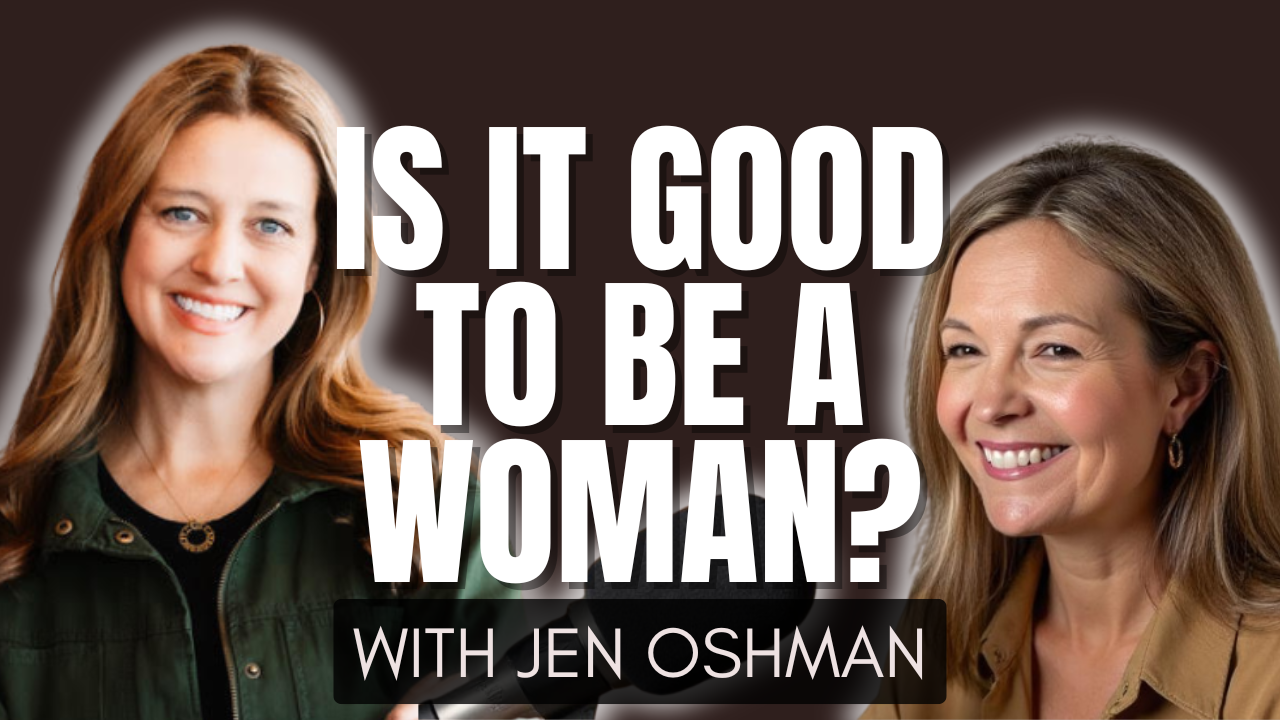
Title: Is it Good to Be a Woman? Exploring What the Bible Says About Women with Jen Oshman
Podcast Date: April 14, 2026
Listen Here:
Description
In this deeply honest and theologically rich episode, Heather Creekmore welcomes Jen Oshman—author, missionary, and mom of four daughters—to tackle a question many women silently struggle with: Is it good that I was born a woman? Together, they candidly explore how issues of body image, shame, and the cultural pressures of womanhood can lead to deep-seated doubts and frustration.
Drawing from global and biblical perspectives, Jen Oshman shares insights gathered from years of cross-cultural ministry and studying God’s word. She addresses the vulnerabilities women face, both physically and socially, and how Western and global cultures shape our understanding of femininity. Jen Oshman unpacks what the Bible says about being female, highlighting the unique and powerful stories of women in Scripture that often get overlooked, and discusses why God’s design for women is not only intentional but also very good.
Key Topics Covered
- Why the question, “Is it good that I was born a woman?” is more common than we realize
- The impact of shame, fear, and the lived realities of being female in our culture
- How body image struggles can be rooted in deeper frustrations about being a woman
- A biblical look at femininity—separating culture’s checklist from God’s truth
- The meaning of “helper” (Ezer) in Genesis and its empowering implications
- Why diversity among women in Scripture matters—and what we can learn from their stories
- Studying tough Old Testament laws (like menstruation) in context and seeing God’s heart of care for women
- Practical encouragement for women who wrestle with their purpose and God’s plan for their gender
- How to dig deeper into biblical womanhood with Jen’s new Lifeway Bible study, “Very Good”
Connect with Jen here: https://www.jenoshman.com
Grab a copy of Jen's new Bible study: "Very Good" on Amazon here.** Amazon affiliate link. Tiny portion of your purchase goes back to supporting this ministry.
Want to go further in your body image healing journey? Discover the resources, books, and programs Compared to Who? offers to help you improve your body image here: https://www.improvebodyimage.com
Transcript
Disclaimer: This transcript is AI-generated and has not been edited for accuracy or clarity.
Heather Creekmore [00:00:00]:
Jen Oshman, welcome back to the Compare to who show. It's been a little while.
Jen Oshman [00:00:03]:
It's been a while. Thank you so much, though. I'm excited to be back with you today.
Heather Creekmore [00:00:07]:
Well, I'm excited to have you join me for this conversation that I think is going to touch a nerve, a place for a lot of women that maybe they didn't even recognize, needed to be touched.
Jen Oshman [00:00:22]:
Yeah.
Heather Creekmore [00:00:23]:
And the topic is, is it even good that I was born a woman? You know, I think women with body images especially, there's so much shame around the body in general that sometimes that can spill over into, like, man. It would just be better if I'd been born a man. You know, I hate all of this woman stuff. I hate the pressure. I hate, you know, the feeling of, like, having to compete as a woman in this world. All of. All of those things that swirl around what it means to be a woman, especially here in the West. And you've been studying this.
Heather Creekmore [00:01:06]:
I know. And so I thought you'd be the perfect person for a conversation. Just tell us, Jen, like, is it good to be a woman?
Jen Oshman [00:01:15]:
Yeah, it is a fair question. And you're right, it's something I think about all the time for a number of reasons. One, I have four daughters who are now 18 and older, and we raised them all over the world. So we were missionaries in multiple different countries. And so I. I kept coming up against this idea of what does it mean to be a woman in this culture or in this culture? How are women treated in the church over here or over here? Of course, everywhere we go, when we have four girls in tow, people make comments. And I know that they mean well. I know that it's small talk.
Jen Oshman [00:01:50]:
I know they mean to be funny, but. But the reality is, the root of their comments is a sinister belief that I think we've ingested as a people and I would argue globally. I mean, for sure, body image is an issue, especially in the west, but when we leave the west, we actually confront this whole global idea that girls are less desirable. In fact, female genocide or infanticide is not. Is not a history. You know, there, there is sex. Selective abortion remains prominent throughout the world and is not something that's protected everywhere in the United States. So this is.
Jen Oshman [00:02:36]:
It's a heavy topic. And so, like I said, when we leave the house with four girls, you know, we get funny comments. And my girls and I have actually come up with a number of very sort of pithy, kind, but firm responses to stop people in their tracks. But the truth Is it can be dangerous to be a girl. It can be very vulnerable to be a woman. And there are lots of good reasons that some women wonder if it would be better to be a man.
Heather Creekmore [00:03:05]:
Right, right. Well, you know, I didn't know we were going to go here necessarily. But just as you're sharing that, I'm thinking back to my 20s. I was single until I was in my early 30s. And all those years I spent as a young profess, traveling alone, going to my car at night alone, you know, all of those things. And remembering feeling, like, resentment that I had to be scared. If I was a man, I wouldn't
Jen Oshman [00:03:38]:
have to worry about it.
Heather Creekmore [00:03:39]:
If I was a man, you know, I could, you know, I'd have more freedom, those sorts of things. And so, yeah, is an interesting maybe setup that we have for shame. Yeah. Right. I mean, is that what you call it?
Jen Oshman [00:03:57]:
I think so. That's definitely part of it. You know, the reality is that in general, women are going to be physically weaker and physically more vulnerable. The reality is also in most countries and in the US there's going to be an increased vulnerability when it comes to things like pay and benefits and making space for our biological functions of being pregnant and our monthly menstruation and going through menopause. I mean, all of these burdens that are unique to being female. And the reality is our culture and our practices, the workplace, compensation, promotion, these things are really set up around a sort of normal male biology and make it hard to be female in these places. And so you're right, I still think about my safety when I walk around, you know, when I'm anywhere. I travel alone all the time.
Jen Oshman [00:04:52]:
I have trained my girls very specifically to have their shoulders back and their heads up, up, and to look people in the eye and to not, you know, So I think, yeah, shame is part of it. I think part of it is our lived experience being fearful or being abused. One in three women is abused. All of us know at least one or multiple women who've been abused. So it's shame. I think it's fear. It's just the lived reality that it's harder to do a lot of things in the world, even in the church, even in our. Amongst our friends and family as a female.
Jen Oshman [00:05:30]:
And so the question is, what do we do with that? You know?
Heather Creekmore [00:05:34]:
Right. What's the good news, Jen? I mean, you know, scripture has something to say to us. What's the encouragement here?
Jen Oshman [00:05:42]:
Yeah, it's true. It can feel heavy. And I, you know, I wrote a children's book a few years ago called It's Good to be a Girl. And so there have been endless jokes, of course, amongst my own daughters and friends and family who will say things like, oh, it's good to be a girl.
Heather Creekmore [00:05:59]:
Right?
Jen Oshman [00:05:59]:
You know, or like, what about when it's not good to be a girl? And so as someone who loves God and loves his word and loves his people, I do want to know, what is the good news? Like, why do I think that it is good to be a girl? And I think we have to just come back to a biblical perspective and an understanding of who our creator is, our creation story, how he created us. There's a lot in there that I think as a culture, we have glossed over. We're like, yeah, God created the heavens and the earth, blah, blah, blah, blah. Let me move on. Let me go to these harder texts. And there's so much that we miss, even in that fundamental reality of how we were made. Very good. So I keep wanting to bring my conversations back to that.
Jen Oshman [00:06:44]:
Like, okay, cool cultures told you this. Your lived experience is this. That's all valid. But what does the word of God say? What does God say? What is fundamentally true about you as an image bearer who is female? True regardless of what culture says. True regardless of what your experience is. What is the. The foundation of this conversation?
Heather Creekmore [00:07:08]:
Yeah, I love that. Because femininity is defined for us countless ways. Right. To be feminine is to look like this, or to be feminine is to stand up for this cause or to be feminine is. You know, there's accounts that call themselves biblical womanhood, accounts of so many things that I'm like, oh, my goodness, like, no.
Jen Oshman [00:07:36]:
So, yeah.
Heather Creekmore [00:07:37]:
What does it mean to be feminine?
Jen Oshman [00:07:39]:
Yeah.
Heather Creekmore [00:07:40]:
According to scripture.
Jen Oshman [00:07:41]:
I love this question. And I am with you, Heather. I am exhausted by the takes on this. Absolutely exhausted. Because everybody's got a loud agenda. And I can't tell you, being someone who writes a lot about what it means to be female, I get dms and questions all the time. Women want to know, what is biblical femininity and how do I do it? Like, give me the checklist. Everybody's dying for the checklist.
Jen Oshman [00:08:04]:
And they're very disappointed when I write back and say, you know what? The scriptures actually have very few gendered instructions. There's not a lot. As if you look at the whole story of the Bible and interpret the Old Testament in light of the New Testament and sort of take it as one package in light of Christ and in light of the, you know, the light of the creation account, put it all together, what we find is there are very few gendered instructions in the Bible. And so what I want to do is constantly take people back to Genesis. And I know that it might feel elementary and it is, but it's something we're missing. And it is that the creation account, specifically Genesis 2, where God, you know, we get sort of a zoomed in version of the story where God creates Adam from the dust of the earth and his breath, and then he says, he puts Adam in the garden, gives him these instructions, and then says, wait, Adam, it is not good that you are alone. We have this refrain over and over in creation. And it was good, and it was good and it was good and ultimately, and it was very good.
Jen Oshman [00:09:07]:
But then Adam's alone and God is like, Adam, it's not good that you're alone. And so let's just pause right there because what that tells us is that the image of God requires an expression in male and females, that there's more that God wants to say about his image and his character and what he's like than can be expressed in men alone. Not only that, but the tasks God gave to Adam to cultivate the earth, to rule and subdue creation, to cultivate culture, was a task that was given to both Adam and Eve. It was something that couldn't be accomplished by Adam alone. That was what was not good about. Couldn't be done without a helper. And I'll just briefly say this, and then we can go in a different direction if you want, but the. I don't.
Jen Oshman [00:09:55]:
You've probably talked about this before, but I think it's never boring to repeat that. That Hebrew word for helper is a very strong word. It's Ezer. And it has connotations of protection and being a shield and being an ally. It's even a word that's used of God more than anything else in the Old Testament scriptures. So we know if God is called an Ezer when he calls, even as air. This is dignified, this is powerful, this is strong. This is not secondary.
Jen Oshman [00:10:24]:
It's not an afterthought. It's not an assistant or an intern who gets the coffee. It is somebody who is necessary. Or the task cannot be accomplished, or the war cannot be won, or the victory cannot be attained unless the helper comes on the scene. So right there, if we just slow down in the creation story, we're already seeing some significant truths about what it means to be female.
Heather Creekmore [00:10:48]:
Yes, I love that. And it does make me wonder why We've, you know, always defined helper so differently.
Jen Oshman [00:10:57]:
Right.
Heather Creekmore [00:10:57]:
Like, we, we don't have enough good words for some of these biblical concepts. And so I think that's so important that you mentioned that. And I was just thinking about, like, one of the things that I talk to women about in terms of finding some level of freedom with body image issues. Right. Is knowing your purpose. Right. And I don't mean that in a specific, like, you know, I'm supposed to have this job kind of way, but like, really, what were we created for? And of course, some of that is gender neutral, if you will. Right.
Heather Creekmore [00:11:31]:
To worship God, bring glory to God, to know him, make him known. But in and of itself. Right. Being born female does give us more hints about our purpose, doesn't it?
Jen Oshman [00:11:47]:
Yes, I love that. So what we. The reality that Eve was needed shows us that the genders are not interchangeable, that it's to be male and to be female is distinct and both are necessary. So right off the bat, we know it's very good to be male and it's very good to be female. What I love, as you study the scriptures with this sort of lens on of like, okay, what does the Bible tell me about being a woman? What are the women in scripture doing? What it. Let's just put those lenses on and it will radically change the way you read the Bible. But one thing I love to see is how incredibly diverse the women in scripture are. There is just no cookie cutter.
Jen Oshman [00:12:29]:
But what you also see is oftentimes because of their gender, they are allowed to do certain things or they can leverage their role in society specifically because they're women, which I think is so powerful. Like, one of the first stories that I think of is the Hebrew midwives Shiprah and Pua, who the, you know, Pharaoh said, I want you to do away with murder all the Israel boys that are born. And Shifra and Pua refused to disobey the Lord their God. And. And these women literally deliver Israel, you know, that's amazing. Yeah, they protect these, the baby boys and they deliver up another generation of Israel. And they can do that because they're women. And you just start to see that time and time again throughout the scriptures as well.
Jen Oshman [00:13:20]:
God made her female, therefore she could work in this space and do this thing. And I think that that's pretty mind blowing when you start to see the stories through that lens.
Heather Creekmore [00:13:29]:
Yes, I love that. I love that. Well, you just wrote a book on this, so that's why you've been studying it. I want you to tell us more about that book. But first, there's a woman listening today. I am sure that's thinking, okay, yeah, that's nice. I know about. I know there's women in the Bible.
Heather Creekmore [00:13:49]:
I know I'm made in God's image, but I still just really hate being a woman. I hate all that's entailed there. I just. How would you encourage her, Jen?
Jen Oshman [00:14:00]:
Yeah, I actually run into women who feel this way quite a bit and it's kind of a thing. Well, here's, here's what I see. A lot of times women don't know that they feel that way and it bubbles up, you know, once you start to talk about it, they go, actually, I think this is what I feel. And there's women who are very aware that they feel that way and it's been a fight to be content or they even haven't found contentment yet. So I do think it's something that we should go ahead and name. Like, this is here because a lot of us grew up with fathers or in households or maybe teachers or coaches or pastors or church leaders who said it outright or said it in some other way that it kind of wish I had had a son. It's too bad you have those strong gifts because they go better on men. You know, we've just received that.
Jen Oshman [00:14:52]:
Like, this is kind of the cultural waters that we're swimming in. We have either heard it from a loved one or a leader, or we've ingested it from social media or movies or music. Let's just be honest, as girls, we have heard that. So I think it's good to name it and it's good to go. That's actually just not true. That is something the enemy has used. The enemy who hates the image of God, who hates women, who hates to see women free and thriving and flourishing. This is something he's actually whispered in my ear and I'm going to go ahead and identify it and I'm going to reject it.
Jen Oshman [00:15:27]:
This is not from the Lord. So I think we have to work hard to take every thought captive. And those things that play over and over, unquestioned, rent free in our heads, no time is up on that, right? We're done with that. That's good. And then what if we started to study the scriptures? Like, what if we really dove in with a new lens of like, what it. Why. Why is it good to be a woman? What are the. What's the good news I see in here when I teach stories at conferences and at retreats that highlight the stories of women.
Jen Oshman [00:15:57]:
It is crazy how many women who are older in the faith who are like, man, we just studied that entire book, and I never heard these stories of the women. And their pastors aren't sexist and they're not out to be mean or whatever. They've just missed it. Like, they've made the heroes of the story a lot of the time. Just the men in the story.
Heather Creekmore [00:16:17]:
Yeah.
Jen Oshman [00:16:17]:
And so I have. I have compassion for that, and I reserve judgment. I'm not. I'm not saying that they're on a mission to degrade women, but women who've been walking with the Lord and reading the Bible for decades say to me all the time, I just never saw that. I never heard that. And I'm like, well, it's right there. It's as black and white as the story about the men that you've heard. So let's start elevating these stories and really seeing them because they're there.
Heather Creekmore [00:16:39]:
I love that. I love that. Well, I guess one tool we could use to study the women is this new Bible study you have. Right. Can you tell it's a book and a Bible study, or are they all together in one?
Jen Oshman [00:16:50]:
It's just a Bible study.
Heather Creekmore [00:16:50]:
Just a Bible study. Okay, tell us more.
Jen Oshman [00:16:52]:
Yeah. Oh, man. This is like. I feel like this is my most important, like, the work of my life, and I'm so excited that it's out. It is seven teaching sessions that are all digital and online where I teach from God's word, and then six weeks of personal study five days a week. And it's a basically a biblical theology of being female. I go from Genesis to Revelation and study what the Bible says about being a woman.
Heather Creekmore [00:17:16]:
Wow.
Jen Oshman [00:17:17]:
And the study's called Very Good because, honestly, I know. Listen, I do not shrink back from those hard passages, the hard Old Testament law about women where you're like, I'm sorry, what does that. What is that telling me to. Some of Paul's words about women that were like, this is not sitting well with me. Like, I don't shrink back from any of that, but I help you study it. In light of the whole story of scripture. And what I'm thrilled to report back is that as we use scripture to interpret scripture, as we understand God's heart for women, as we understand Jesus's relationship with women, the bottom line is what the Bible says about being a woman is truly very good.
Heather Creekmore [00:17:57]:
I love that. Okay, without giving away too much of the book, what was, like, your favorite thing? Like, what surprised you the most or you were like, whoa, this, this is, this is good.
Jen Oshman [00:18:09]:
Okay. Oh my gosh, that's really hard to pick.
Heather Creekmore [00:18:13]:
I know.
Jen Oshman [00:18:14]:
I think I'm going to, I'm going to tell you the one that feels most pertinent to this conversation.
Heather Creekmore [00:18:18]:
Okay.
Jen Oshman [00:18:19]:
But I'm just also going to say that I really love studying Jesus and women.
Heather Creekmore [00:18:22]:
Okay.
Jen Oshman [00:18:23]:
And also Paul and his co laboring women. It like blew my framework of Paul. I think it would blow yours too if you studied it. So Jesus and women is like chicken soup for the soul. Yeah. Paul and women is like, oh my gosh, this is blowing my mind. Okay. But here comes my real answer.
Jen Oshman [00:18:40]:
Okay.
Heather Creekmore [00:18:40]:
Okay. That's a good teasers.
Jen Oshman [00:18:44]:
So back to the law. Studying the ancient, the law that's given to ancient Israel in the Old Testament. And there's, I mean people have PhDs on this. So we can't go, we can't talk about it all right here. We can't talk about it all in my Bible study. But I was especially curious about the menstruation laws. Like what is going on with the fact that women are supposed to be secluded for seven days of their period and then seven days after their period. It, as a woman in 2026, when I read it feels unfair.
Jen Oshman [00:19:17]:
It feels like I'm being sent to timeout for having a period that I don't really want to have. And the, you know, like, Lord, you gave us our periods, so why are we doing this? Right.
Heather Creekmore [00:19:28]:
And I'm thinking, Jen, before you continue, I'm thinking it would have been better for me to be secluded seven days before my period. That week after is great for me.
Jen Oshman [00:19:38]:
That's probably fair. That's probably fair. So to get to the bottom of this requires so much work and we cannot do it in this particular conversation all the way. But I want to tell you this. As I studied the Old Testament culture that made a big difference, like the representation and the protection that fathers and oldest brothers were supposed to offer the women in their family. And I want to really, I really want to highlight the representation, the responsibility, not the authority. We do not see authoritarian rule in the Old Testament, but we see a representation and a responsibility. So that was big.
Jen Oshman [00:20:17]:
Men were sort of out there representing the women in their household in the public sphere in every way. So there's that. Then there's this whole issue of blood and Israel believing rightly so that life is in the blood. And blood under a sacrificial system is a really big deal. So they're, they're wanting to be extra when blood is present, Israel is like, hang on, we got take note. We need to be very careful here. It's also a system, a sacrificial system where there, there is ritual cleanliness, ritual uncleanliness, moral cleanliness, moral uncleanliness. And so there's this idea that when a woman is bleeding, she's ritually unclean, not morally unclean, but again, because there's blood, Israel's, you know, has this heightened awareness and is like, we need to be careful.
Jen Oshman [00:21:08]:
She's bleeding. So this law that said women need to go basically have a rest, take a rest, you get your own bed, you get your own stool, you get your own chair, you don't do any household chores, you don't do any cooking, taking care of the children is needs to be done by the rest of the household. It's essentially the week of your period and the week after is meant to be spent resting and recovering for the protection and the care of the women.
Heather Creekmore [00:21:39]:
That's amazing. I, I, I'm sure I'm going to mention this to my husband later.
Jen Oshman [00:21:43]:
Yes.
Heather Creekmore [00:21:44]:
This is biblical. I need two weeks, Bob.
Jen Oshman [00:21:47]:
Every month I'm gonna need you to cook dinner for the next two weeks.
Heather Creekmore [00:21:50]:
Right.
Jen Oshman [00:21:51]:
Oh, anyway, I didn't do it justice, but if you spend time understanding the history, the context and the care and the law and the presence of blood, what you, what un actually is that God's heart is to go to an extreme to protect women and girls. And I love that and I see that all over the scriptures.
Heather Creekmore [00:22:09]:
Yes. That sounds, I mean, what you just described is a sentiment of care, not a sentiment of, ew, stay away, let me punish you. And I just don't think we've read it that way.
Jen Oshman [00:22:22]:
Right, right. It requires work. Like, if we want to know really what God is saying, we're going to have to do some work. Pulling out these sound bites and running with a little clip is doing us any favors. And it's actually attributing to God things that aren't true about him. So I want to invite women to do the hard work of really understanding what the scriptures say.
Heather Creekmore [00:22:42]:
Yeah, I, it's so good. And in a culture that has a million clips a minute is probably not even overstating a million clips a minute of how to be a woman, what it looks like to be a woman, how you can be a better woman, how do you be the best woman? To tune that out and to tune in to what is God really saying here? What is God's heart for Women. He sees us as very good. Like Jen, perfect title, and I just love that. I'm wondering if, as we close today, would you be willing just to pray for women who are really struggling with this? I mean, you mentioned a minute ago that, you know, not everyone knows this is the heart of her struggle. And before we started recording, I kind of shared with you like, like, same here. As I talk to women, as I coach women, no one comes in with that as the lead. But the more we dig, we often find that maybe what's beneath my body image issues is I'm just frustrated I was born female.
Heather Creekmore [00:23:50]:
So would you, would you be willing to pray for the woman who's struggling with that today as we close?
Jen Oshman [00:23:55]:
I would love to do that. And I also want to invite that sister to open up the Bible and in the Gospel of Luke and go through with pen and paper and take notes on every interaction that Jesus has with women. I was so ministered to as I saw how Jesus never was ashamed of women or embarrassed to be with women. Like he received the embrace of women. He embraced women. The way Jesus treats women, I. I want that to saturate our thought life because that's God's heart for women. So do that.
Jen Oshman [00:24:25]:
And then in, in line with that, let me pray for us.
Heather Creekmore [00:24:28]:
Thank you, Jen. I love that.
Jen Oshman [00:24:31]:
Jesus, we are so thankful that you love us so well that you are not inconvenienced by women, annoyed by women, that you don't look at any girl ever created in your image and say, man, she should have been a boy like you made us girls and women on purpose, for a very good purpose, Lord. So we thank you that you made us this way, God. And on behalf of my sisters who don't feel thankful, Lord, I pray that they could borrow my faith and borrow my gratitude and trust by faith that they will eventually see, see through your scriptures and by the help of your spirit that it is good to be female. Lord, would you renew our thoughts? Would you just capture our imaginations, the things that we sort of wake up thinking about or dwell on when we're at a traffic light or cooking dinner or walking the dog? Lord, bring us back to the truth and that is that you made us just like this on purpose for a very good purpose. Lord, help us to believe you. Help us to walk in that strength and that truth, Jesus, for your glory, for our good, for the good of our daughters and our sisters and our mothers and our grandmothers. In Jesus name, amen.
Heather Creekmore [00:25:40]:
Amen. Oh, I love it. Thank you so much. Jen, appreciate that so much.
Jen Oshman [00:25:43]:
Thank you, Heather.
Heather Creekmore [00:25:44]:
Okay, tell us all the things, like where we can connect with you. You've got the new Bible study out, but you had a book that. That was the reason you were on my show years and years ago called Enough About Me, which was a fantastic book. I would highly recommend it. Tell it you. You've a lot of things in between the last time we talked, so just tell us all the things and where to connect with you.
Jen Oshman [00:26:03]:
Yeah, well, I have a website, jennosman.com where you can find my books and some other writings and podcasts and things like that and. Yeah, very good. It's a Lifeway Women Bible study. You can find it on Amazon or at Lifeway. Yeah. And I would love to keep up with anybody on social media. This is a passion of mine and I love to connect with women and just be an encouragement and a voice. So thank you all for listening.
Heather Creekmore [00:26:26]:
Thank you so much. And I'll put those links in the show notes. Well, Jen, thanks again for being with us today and encouraging us around this really important topic. This is foundational, so thank you. This conversation is long overdue and I appreciate you being here for it.
Jen Oshman [00:26:41]:
Thank you, Heather.
Heather Creekmore [00:26:42]:
And thank you for watching or listening today. I hope something today has helped you stop comparing and start living. Bye. Bye.
Tired of fighting your body image issues alone? Do you know that you're "fearfully and wonderfully made," yet still feel like your body isn't good enough?
Sign up here for weekly encouragement and take the 5-Day Body Image Challenge!