How to Set Hope-Filled Goals in 2026 Without Obsessing Over Weight Loss: Feat. Amy Carlson [Podcast Transrcipt]
Jan 02, 2026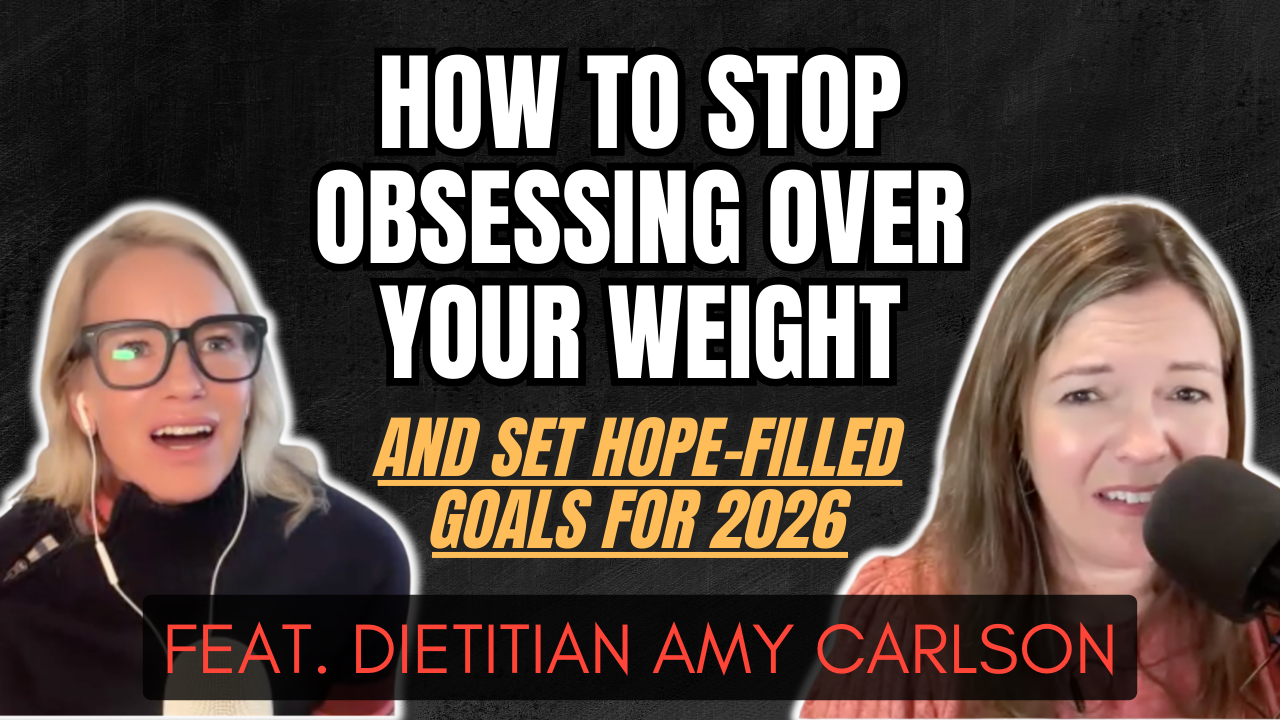
Title: How to Set Hope-Filled Goals in 2026 Without Obsessing Over Weight Loss: Feat. Amy Carlson [Podcast Transcript]
Podcast Date: January 2, 2025
Listen Here:
Description
Kick off your new year with a refreshing and hope-filled conversation about the pressure to set body-related goals and the journey toward real freedom. Hosts Heather Creekmore and Amy Carlson dig deep into why so many women set weight loss as their top resolution and how our culture’s diet obsessions impact families, friendships, and faith communities. You’ll hear honest stories, including “are we getting left behind?” anxiety, the latest health fads (GLP1s and fiber, anyone?), and powerful encouragement to seek God’s “how much more” rather than settle for the world’s lesser goals.
Whether you’re a goal-setter, a recovering dieter, or someone wondering what you might be missing by chasing smaller jeans instead of a fuller life—this episode will inspire you to open your hands, journal, and pursue the abundance only God can give.
**Get your FREE Obsessed-to-Blessed Mini course here.
Journal Prompts from Today’s Episode
-
What am I going to miss if I invest my time and energy into weight loss this year?
(Reflect on what parts of your life could suffer or what experiences you might lose out on.) -
What parts of my life feel stunted or neglected because of my focus on body goals?
(Take inventory of relationships, passions, or spiritual growth you could nurture instead.) -
What is my mind telling me ‘my life will begin when…’?
(Finish this sentence honestly and challenge what you believe about starting to live.) -
What am I not asking God for that would truly bring “how much more” into my life?
(Go before God with open hands – ask Him what He wants for you in 2026.) -
Who else is impacted by my health and eating practices?
(Consider your kids, spouse, friends, or community and how your choices ripple out.) -
How does seeking smaller goals (like a certain weight or restriction) limit the breadth of my ‘garden’—my life?
(Picture your life as a garden and consider what fruit you aren’t tending to.) -
“My life will start when…” versus “How much more does God have for me?”
(Contrast your answer to these two prompts and pray for wisdom to pursue God’s best.)
Bonus: Community Conversation Starter
If something in this episode resonated with you or led to a new insight or goal, Amy encourages listeners to share their goal or what God is inviting them into for 2026. Imagine how uplifting it would be to see what God’s abundance is unfolding in lives beyond just body-centered achievements!
Encouragement
You’re not behind, and you don’t have to settle for less. Hear stories, biblical truths, and real talk that help you stop comparing and start living with open hands, trust, and greater faith.
Need more support? Learn more about the upcoming 40-Day Journey here: https://www.improvebodyimage.com/40-day-challenge
Transcript
Disclaimer: This transcript is AI-generated and has not been edited for accuracy or clarity.
Heather Creekmore [00:00:01]:
Amy Carlson, welcome to the Compare to podcast again.
Amy Carlson [00:00:06]:
Again. Oh, Heather, I'm so happy to be here, as always.
Heather Creekmore [00:00:09]:
Okay. What I just realized, though, is you were only on the show one time last year, and that is just inexcusable. So apologies for that. And I know the audience is like, yes, yes, Heather, that was wrong. You needed to have Amy on more last year. So sorry. That was, was a fail on my part. So good.
Amy Carlson [00:00:28]:
I'm so excited to be back. I'm so excited to be back, actually. It's such a pleasure when I get to come on here. So, actually, thank you for inviting me.
Heather Creekmore [00:00:36]:
Yeah. Well, I am just excited. It's January and I'm excited that maybe we can have a hope filled conversation. I like that for the woman who's like, okay, well, there's actually, I don't want to just limit it to one woman because there's, you know, we've got lots of different listeners, right?
Amy Carlson [00:00:56]:
But.
Heather Creekmore [00:00:56]:
But I know that there's probably some women out there, like, who always, every year, took this opportunity to jot down some goals.
Amy Carlson [00:01:08]:
Right?
Heather Creekmore [00:01:08]:
Here's what I want from 2026 and for me, every year. And I would, I would love to say that my first goal was like, spiritual growth. And number two was like loving people better. And then number seven was lose weight. But that's not actually the way the goal list read it was number one was lose insert number of pounds here.
Amy Carlson [00:01:31]:
And.
Heather Creekmore [00:01:33]:
And it became my purpose for the year. And I've grown in my journey where I don't do that anymore.
Amy Carlson [00:01:42]:
Right.
Heather Creekmore [00:01:43]:
But I have a feeling. So back to these categories of women, right? I have a feeling there's women listening who still did that, who did that a couple weeks ago and are like, yep, got it.
Amy Carlson [00:01:50]:
Check.
Heather Creekmore [00:01:52]:
And then there might be other women who are like, I stopped doing that. Right. Like, I've, I've kind of grown. I've developed some more freedom. But now I spend five minutes on social media and everyone I know is taking the shots. They're on GLP1s, they're shrinking. And now I'm feeling like, I don't know, maybe, maybe that should be my goal for the year. Otherwise I'm going to be the one who's bigger than everyone else.
Heather Creekmore [00:02:19]:
I don't want to do that. Amy, give us. Give us some hope. Give us some perspective. Like, ground us. Ground us where we need to be grounded as we start off this year.
Amy Carlson [00:02:31]:
I love that sentence that you started with let I. That we would have a hope filled conversation. And that actually is exactly what we intend to do is for people to feel hopeful and just in that. What you. Just those few sentences, you, you just like, we could unpack 52 things because a few things. One, I think it's really natural at the beginning of a new year. It often happens for women at the beginning of the school year as well. We just sort of have that natural sort of, okay, it's the beginning of something.
Amy Carlson [00:03:09]:
So beginning of the school year or beginning of the calendar year. I think it's really natural to reevaluate and I think it's really exciting. As believers, we would maybe even use that language of examine where we would just let the Lord search our hearts and know us and really reflect on 2025 and say, God, what are areas of growth and what are areas that I had anticipated growing in or really, really thought last January that I was going to really dive into? And wow, didn't even touch them, you know, didn't even go there. And I think about that verse, you know, without vision, the people perish. And I. So I think what is exciting is I think this is a really natural, beautiful thing. And especially for. For women who can be very project and organized and Right.
Amy Carlson [00:04:04]:
And it can be very helpful in community when you think about a small group or friendships that, that are just spiritual friendships. And I think the risk, what I hear you saying and what I for sure am seeing in my office, and it was certainly, I mean, if you looked back at calendars, I know we've giggled about this before, but my calendars would have this, like, I would have a big circle, you know, eight weeks from now, and then know, be xing it off every day. The old, like Hallmark calendars, you know.
Heather Creekmore [00:04:37]:
That way kittens, maybe they have kittens on lots of kittens. You're right. And you're just like, wow, I didn't.
Amy Carlson [00:04:44]:
Know I liked kittens until they came on my calendar. So I think, I think the risk is even for women who are walking in ever increasing freedom, that right now you said it in just a couple seconds ago, was, am I getting left behind? I thought we were. I thought we were all in this together. I thought we had decided collectively as women that we were gonna walk in freedom and we were gonna choose this thing. And then all of a sudden you're like, oh, oh, oh. I. I think I'm getting left behind. This is, this is a lot of anxiety.
Amy Carlson [00:05:18]:
I'm getting left behind in my weight. Am I. Am I doing something wrong? I get that language a lot in my office. Am I doing Something wrong. I must be doing something wrong. And so what a great conversation for you. And I have, and I, I have this story that I, you know, I always come with my stories to your podcast, but I was in a public restroom not so long ago, and I was washing my hands, and these two women ran into each other in the bathroom. I didn't know them.
Amy Carlson [00:05:48]:
And the, the younger woman said, oh, my word, you look so good. And the other woman opened her mouth and she, I could tell she was, she was older. And she said, oh, thanks, honey, thanks. She said, I'm just three pounds from my high school weight of 118 pounds. And so I have three pounds to go. And I, I mean, you could imagine what I wanted to do. I wanted to have an intervention. But instead I, I just briefly turned around and I could see she was maybe in her 70s.
Amy Carlson [00:06:19]:
She was maybe in her 70s. And my heart was broken. I walked away. I actually got teary eyed because I thought, oh, Lord Jesus, please let me not be in my 70s, right? And, and let the women that you and I get to talk to not be in our 70s. And managing micromanaging through bounds. And first of all, she's held on to a weight from high school. How many years ago was that? So all I could see was this video montage of all the experiences of her life that she had missed. And so part of this hopeful conversation is not what am I going to do to get this thing? It's what am I going to miss if I choose that, right? So even if the, if we, if you just sat right now with your journal and you thought, okay, I'm super tempted to create a whole project out of my weight in 20, 26, or I, I'm going to start this thing and you know, oh, it's so tempting.
Amy Carlson [00:07:16]:
I'm not going to tell anybody because everyone knows I'm trying to do this differently.
Heather Creekmore [00:07:19]:
Right?
Amy Carlson [00:07:20]:
But what if you just sat and journaled and just asked the question, what am I going to miss if I invest my time in that? What parts of my life will suffer if this becomes the priority? And just sit with that for a second. Let's linger and ask those questions and even do it in collaboration. There's no question. You have these amazing podcast listeners that come back time and time again, and many of them probably have certain, maybe even know each other and they could ask those questions together, you know? Yeah, yeah, sorry.
Heather Creekmore [00:07:56]:
You got me thinking and now you're waiting for another question. I'm like, I don't know, Amy. I'm still, still chewing on that.
Amy Carlson [00:08:02]:
I mean, we're lingering.
Heather Creekmore [00:08:03]:
We're lingering.
Amy Carlson [00:08:04]:
I mean, it's. And, and the reality is, I mean, you know, I get, I get a little bit in my, in my spirit. I get a little. Right. I get a little in my spirit. And I was in session this week. I asked a client if I had permission to share this. I said, I'm gonna share that this week.
Amy Carlson [00:08:24]:
I said.
Heather Creekmore [00:08:25]:
She said, oh, please share it.
Amy Carlson [00:08:27]:
Please share it. But we've been working together for a couple years and again, coming out of the diet culture probably 20 years, I think was really, really deeply embedded in the diet culture. And just, she's coming on this calendar year of just unbelievable letting go and sanctification and letting go of all these things and being so deliberate about this, I'm going to call it, recovery process of letting go of any social media, letting go of even some relationships that were solely built around dieting and those. Right. And being so intentional on letting the Lord do that work in her life. So we were actually talking about this new position she'd taken at her church, which she never in a million years would have thought she would have been worked at a church and all these different things. And I just stopped and I, I looked at her and I said, can you imagine this basket full of fruit that, that would not be here if, if your time had been solely invested in what had been invested for the last 20 years, which was perfect. Eating the next diet.
Amy Carlson [00:09:45]:
And, and by the way, in those 20 years, she never reached that, whatever that, that magic goal. It was. In 20 years, she's never even, she never reached it. It was always this, you know, Looney Tune cartoon mirage in the desert that she was chasing. And she and I both got teary eyed and she just said, oh my word. And so I said, I just see this tree with all of this fruit. And I said, and I have this visual of you pouring into this one tiny section of your garden for 20 years. And it just, it just never grew.
Amy Carlson [00:10:19]:
It just never grew. And when you, when you said, okay, I'm done, I'm. I'm done, and you let the Lord do all this other stuff. I said, it's all growing. You have this flourishing, beautiful garden that's bearing fruit. And she and I just looked at each other, she goes, I just, she said, I can see it. This, this fruit was just stunted. There was no, like, there was no effort, no prayer, no time and attention to these other things.
Amy Carlson [00:10:44]:
I mean, her life is so full. Her marriage, her. Her relationship with her children again this Thanksgiving, some things that had happened to both of her children pulled her aside and said, mom, we want to affirm the work that you've done. You're not the same person as you were when you were growing up. And she just was teary eyed. And they just said, we see it, we see and we want it. And we. Right.
Amy Carlson [00:11:10]:
And it's like, why would we sacrifice that?
Heather Creekmore [00:11:13]:
Right?
Amy Carlson [00:11:13]:
Why would we? And we do, right? We. Over year after year, year over year.
Heather Creekmore [00:11:19]:
Well, because the liar is very good at telling us that it's not. Your life is not going to become more small if you try to chase being small, which is exactly what it will do. But I think his narrative is, your life is going to start, doors are going to fly open, amazing, wonderful things are going to happen. If you could just spend just a little bit of time, you know, a couple weeks, couple months working on getting to be small, then, whoa, the floodgates of blessings are going to come pouring over you. And we believe it, right? Or, or we believe it for like eight weeks. And then we're like, oh, it's not working. And instead of thinking it's not working because this isn't actually the path I'm supposed to be on, it's not working because I'm doing something wrong or I'm just not good at this, or like it becomes the self defeating mentality.
Amy Carlson [00:12:18]:
Yes. Right.
Heather Creekmore [00:12:19]:
But I think like, you know, to your client's story, it's like, well, it, it's so true. We, we have to see that a life lived for weighing my high school weight.
Amy Carlson [00:12:31]:
Right.
Heather Creekmore [00:12:31]:
Would be a very small life.
Amy Carlson [00:12:34]:
Yeah, I like that language.
Heather Creekmore [00:12:36]:
Right?
Amy Carlson [00:12:36]:
I like that language. Actually. I think that actually is really important language.
Heather Creekmore [00:12:40]:
What?
Amy Carlson [00:12:40]:
You just used this idea that the enemy is always the enemy. Right. And he was good.
Heather Creekmore [00:12:46]:
He's actually really good at what he does.
Amy Carlson [00:12:48]:
And that mirage and the lie that my life will begin when in fact I would. Again, journal prompt. Hello. Just write in your journal. Ladies, women, men, if you're listening, write it in your journal. My life will begin when. Because that. I just told you she never reached that weight.
Amy Carlson [00:13:07]:
Right? Like never, never. Not the one that she really wants. She kept losing weight and all of those things, but my life. And by the way, she's incredible. She's just incredible. And to see when she comes on, we are virtual. And when she comes on, I'm like, you're radiant. You're just absolutely radiant.
Amy Carlson [00:13:27]:
She is. She's just absolutely radiant. And I like that language of the mirage or the lie, the expectation is my life will begin or open up or. And again, I'm going to clarify, which I always do. This isn't to say that people can't want to lose weight, that there's. There's nothing in anything that I am ever saying that if you're like, you know, what my body feel, you know, whatever. And again, that. That can be a whole nother podcast that we talk about.
Amy Carlson [00:13:58]:
So it isn't that I'm bad for wanting to lose weight or I'm. I'm less spiritual because I want to lose weight? No, absolutely not. One of the things, though, that is happening and I just. These conversations are in my office again this week is that that is the primary conversation that's happening in church around tables. Right. What am I restricting? They wouldn't use that language. Right. But what diet am I following? But what am I restricting? And also, what am I eating? I had a client come on, and she goes, I'm so sick of people talking about what they're eating, or so sick of them saying, oh, I just need to lose a few more pounds.
Amy Carlson [00:14:36]:
You know, oh, I'm so frustrated. I. And she said, why is that the most important thing that we're. That that is true about us. And so having goals around our health just in general, or wanting to, you know, oh, I haven't. I had a labral tear this year and also had a meniscus tear, so just thumbs up for all that. Right? So this last year and a half, I, you know, went in the MRIs on both things separately. Exciting.
Amy Carlson [00:15:08]:
And. Right. I go to the chirop, the. The double doc who's got the whatever, and he's like, okay, we can send you here and you can potentially get surgery for both of these. These are separate, separate conversations, but neither one is a must for surgery, so. But you can do that if you want. And this is how that looks. And this is how it looks if we do pretty aggressive pt.
Amy Carlson [00:15:30]:
Well, my goal was to repair and to recover from a labral tear. And a torment is because I'm not ignoring that health goal. That's not. I'm not vain, because I would like to use my shoulder. And guess what? I can actually. I could not let this. I could not get my arm back this way. And now I can.
Amy Carlson [00:15:51]:
And I could even put it behind.
Heather Creekmore [00:15:53]:
Yay.
Amy Carlson [00:15:55]:
Very excited. Goal accomplished. Goal accomplished. And so it is not weird that we have goals or expectations around our body or even around our eating. We can, you know, right now, fibers coming into the spotlight, which my Husband is so sweet. He's. He said, I'm sure you know this already, but I read an article so sweet. He said that more than protein, they're saying fiber.
Heather Creekmore [00:16:22]:
Fibers back.
Amy Carlson [00:16:23]:
I think it's so sweet when he. When he gives me nutrition information. I said, you know what, honey? Honey, it's true. And I said. And I said, one of the things that happens is the. The poor carb manufacturers, they can't get. They can't get carbs to come back. But I said, but fiber is a different word.
Amy Carlson [00:16:40]:
Right, right. And that's gonna sell, right?
Heather Creekmore [00:16:42]:
It's gonna sell.
Amy Carlson [00:16:43]:
So I said, so? And he goes, oh, really? I said, yeah. Those poor, you know, people who manufacture carbs are like, for the lover, can the grains come back? And I said, so fiber is another way to say. And he goes, oh, interesting. I said, not that we don't need fiber. I said, but now the fiber is going to take this glorified role, you know, and we can have that goal. We can say, you know what? I don't need a darn piece of fruit. I'd love to do that. I'd love to.
Amy Carlson [00:17:12]:
Or I'd like to eat more seasonally. You know, I'd love to. To maybe reduce the amount of travel time my food has to take. Great. Let's eat seasonally. I'd like to make new recipes. I'm always in sessions. We talk about meal planning because it's so helpful for our mind space when we have an idea of what we're going to cook in the evening.
Amy Carlson [00:17:31]:
That's not disorder. That's not weird. Right. So these are all lovely things. They don't have to be the number one thing that we're talking about in every circle. Oops. And then they also don't have to be. Right.
Amy Carlson [00:17:44]:
The most important thing I'm doing then have to be the most important thing I'm doing. But it doesn't make us less spiritual because we want to be healthy.
Heather Creekmore [00:17:52]:
Right, Right. I love that. And I'm actually. I was laughing at myself a little bit because I vividly remember sitting in. It's just like a turning point in my life because I was a. I don't know if there needs to be a term for a food sharer or a food diary sharer or something. Like, I was the person who would just casually, in conversation with my husband or when he was my fiance, boyfriend, you know, so he would understand that it was okay for me to eat whatever I had ordered. You know, I was the one who would be like, well, you know, I didn't eat anything until noon.
Heather Creekmore [00:18:28]:
And then I just, you know, had a small salad. And so that's why I had to order this, you know, steak and potato and all the things. Like, I was that person, and I was at. We were at a hotel, and it was the hotel breakfast, and I was sitting so, like, they were like cocktail, like, high tables, and I was sitting kind of pretty close to the person beside me, and I heard her rattle off to her boyfriend, husband, everything she'd eaten yesterday.
Amy Carlson [00:18:54]:
Wow.
Heather Creekmore [00:18:54]:
And it just really got me. I was like, that is the craziest conversation to over here. Like, he looked like he couldn't have been more bored. He could have cared less what she had to eat all day.
Amy Carlson [00:19:09]:
I don't even know what you're saying, girl.
Heather Creekmore [00:19:12]:
And. And so that was a turning point for me. I was like, wow, I need to stop doing that. That's kind of ridiculous. And of course, like, I. I was doing it to make sure that he knew it was okay for me to eat because I hadn't eaten too much or all those things. And anyway, I'm kind of taking us off on a tangent here where we're.
Amy Carlson [00:19:30]:
Going, but it kind of makes me want to go back and hug that, because, honestly. Right, of course. I mean, again, if you and I could go back and dig up those old. Right. Food journals and food over and over and over. And the evaluation. The over evaluation. Right.
Amy Carlson [00:19:49]:
I mean, the overvaluation of. Of. Of whatever. And again, these. I know we've had this conversation on here before. I just think it's funny because I'm a little older than you, but when we were in that era, right. Fat was the demon, right? I mean, when you think about potato chips that had stuff. Olestra.
Amy Carlson [00:20:09]:
Olestra made you have diarrhea, right?
Heather Creekmore [00:20:11]:
Yes. Oh, wow.
Amy Carlson [00:20:13]:
Right. And you think that sounds insane. I mean, it sounds now sounds. And of course, my young, sweet clients, they're like, what are you talking about? You know, give me an avocado, give me some nuts. You know, They're. They're over. They're just like, what is that even. But I use it so often to go, if that sounds insane today.
Amy Carlson [00:20:33]:
And that was research, quote, unquote, right? The top cardiologists, science, everything. Okay? So let's. I'm like, let's think about it. Let's think about it. It's always comes back to moderation. In fact, I said this to somebody this week. I said, maybe it was my husband. My husband, Right.
Amy Carlson [00:20:52]:
That it actually. Nutrition actually doesn't change, the cultural rules change. So how it's been for 50 years, how it's been for 100 years, how it's been for great whole foods variety. Right. Just a lot of different. I mean, and again, that's not, we're not talking about perfect eating, but the, the overall kind of science crux is the same. It's the same. And so, but the food rules change and the cultural biases change and food industry and what it's pushing and what it's, what's, what's being magnified.
Heather Creekmore [00:21:26]:
Right.
Amy Carlson [00:21:27]:
Changes. And so it's like, wait, if I can recognize. It's not like, I mean, that was all food industry driven. The fat, the no fat. I mean, that was all.
Heather Creekmore [00:21:35]:
So it's like, and even the low carb. I did an episode, it might have even been last year on. There's a book called Low Carb Fraud, but it exposes how it wasn't a doctor or a scientist that actually perpetuated the low crop. It was a guy who wrote a book. He was a journalist. Yeah. And he took a study that no one else interpreted the same way. He interpreted the study in a particular way to make his point in a book.
Heather Creekmore [00:22:03]:
And, and now your doctor will prescribe that you be low carb based on the work of a journalist on a journalist.
Amy Carlson [00:22:10]:
Right. That's a, that's exactly right. And honestly, what's interesting too is there's so much siloed research and people are filling their mind with, oh, and again, I, I, there's no judgment here. I can understand people who, who are having, Right. There's symptoms and different things and they're trying to figure stuff out. But there is so much, I'm going to call it pseudo research with pseudo experts that are, and there are a lot of them kind of saying the same thing so that you start to go, well, this must be accurate, this must be true. And it's unsustainable, actually, so that so many clients come in so burnt out, so exhausted and so defeated because they feel like if I cared about my health, I should be able to do this thing if I really cared about my health, but I can't. And I don't know why I'm such a, you know, and it's like, well, first of all, it's unsustainable.
Amy Carlson [00:23:08]:
It's, it's, it's, and it's unrealistic and it's unhelpful. And what looks more moderate and more just like, yeah, this is, this is totally living. And again, going back to the, the woman that was three pounds away from high school weight, which actually just makes me just want to cry. It's like, how much life did she miss? And, and is she more healthy? By golly, she's in her 70s. Well done. Right? Well done.
Heather Creekmore [00:23:32]:
You're there.
Amy Carlson [00:23:33]:
You're there. Yeah.
Heather Creekmore [00:23:35]:
What, yeah. What did it cost?
Amy Carlson [00:23:37]:
What did it cost? Yeah.
Heather Creekmore [00:23:39]:
And, and is food supposed to be this hard? Yeah, I mean, I think that's, that's, you know, that's really a question that you have to wrestle with because it does feel like growing up in this culture, it feels like food is supposed to be hard and food is supposed to be something that, especially if you're a woman, you spend a lot of time trying to figure out and optimizing and, you know, optimizing. And so it's like, whoa, was it supposed to be this hard? Like, is this, like, is this actually supposed to be as big a part of my life as I've made it?
Amy Carlson [00:24:15]:
And, and it's really, really driven by consumerism. You know, back in our day. I'll excuse in our day, you know, you would buy a book and you'd read the book, and then maybe there might even be a book club about it. Right? And maybe there were some products, but it was. But now you're inundated 24 7. And you and I have had this conversation again, it's probably a different podcast, but a different episode, I should say on here. But, you know, a couple years ago, there was a culture a little bit more of, I'm going to say, maybe the health at every size and just a lot more body acceptance and body neutrality. Well, with the rise of right chads, there is now a culture of emaciation.
Amy Carlson [00:25:07]:
And it starts in Hollywood. It's there, it's, you know, influencers. And, and so what was once this kind of joyful acceptance that was like, oh, I'm so glad we're headed this direction. All of a sudden he's like, quick left. We're taking a quick left. I didn't know this was possible. I was fine going down this road until I knew this was possible. Right now I don't have to be okay with this body.
Amy Carlson [00:25:31]:
I'm going to take a quick left. And again, the, the, the. There's no accusation for. I mean, they are, they can be very helpful, very useful. And, and again, that's. Could be another episode, but I. About a cultural shift of emission where there is a very, very thin ideal. And it's.
Amy Carlson [00:25:55]:
Who's questioning it? We've kind of asked that question. I have another precious client again, all of these I've gotten permission to share. But she, again, different client, come out of many, many, many years of eating disorder, severe anorexia, diet culture, all the things very involved with their church and homeschool co op. And she said, Amy, I have about one mom friend that eats. She's like, I'm there packing. When I pack my kids a lunch, you know, I pack my lunch. And she said, but these moms aren't eating. And this one mom in particular, that's a pastor's wife, and she said, I've never seen her eat, not one time.
Amy Carlson [00:26:37]:
And when I say, oh, did you not bring your lunch? Oh no. You know, and she said, I'm so embarrassed because I'm the. I am I. Is there something wrong with me that I'm eating? That's the culture that we're in that I feel weird that I'm eating lunch as an adult. Right.
Heather Creekmore [00:26:57]:
So, yeah, because it's back to the high school mean girls. Like, if you're not just drinking a Diet Coke.
Amy Carlson [00:27:02]:
Right, right, right.
Heather Creekmore [00:27:03]:
Ew, you're eating food.
Amy Carlson [00:27:05]:
You're eating food. What are you doing? Right? I, it's. And she just, I love her little imagery of her taking her, you know, sandwich out and she's just like, I'm sorry, is nobody else eating? And I, it just makes me want to, I want to erupt because I'm like, guys, this is, this is not okay. And by the way, again, Anonymous, anywhere in the country, it could be this, this mama's kiddos, when they're, when they go to birthday parties, they're just, they're eating and eating because they're not used to having freedom around food. And so there's some evidence that that's actually having an impact on, on children. And so I think that's the other thing is this whole very, very thin focus, but also over, over. I like the word optimization that you use because that's really kind of a, a buzzword. Right.
Amy Carlson [00:28:00]:
And optimize my nutrition. I' My health is a very, very siloed, individualistic. And as believers, I'm crucified with Christ. There's no longer who lives. Christ lives in me, the life I live in this body. And I live by faith like it is a community effort. And if my eating whatever this is impacting my children or spouse or. Right.
Amy Carlson [00:28:23]:
This is something I have to evaluate if I'm. It's like if I'm causing. It is actually, it is, it is actually Worth evaluating as a believer to go. This is not just impacting me. Who else is this impacting? Right. How do the women feel around me? And I'm not talking about just eating because, you know, I don't want to make them feel good. But I'm saying this is. This is.
Amy Carlson [00:28:49]:
This is us as women giving each other permission to be human. Oh, what a wonderful opportunity can be.
Heather Creekmore [00:28:56]:
The basic human need and meet.
Amy Carlson [00:28:58]:
It's like. It's like, I wouldn't expect you to be, you know, in Minnesota right now. It's freezing where I'm from. I live in Houston, originally from Minnesota. I wouldn't. I wouldn't. It would be strange to me if you weren't wearing a coat. But you're like, I don't need a coat.
Amy Carlson [00:29:12]:
I don't. I don't. Basic human need to be warm. Right? No, I'm. I'm. I'm. I can overcome it. I don't have to wear a coat in 30 below.
Amy Carlson [00:29:21]:
It's like, oh, that's weird. It's equally as weird that you don't need to eat, I think.
Heather Creekmore [00:29:25]:
Right, Right.
Amy Carlson [00:29:26]:
You know? Yeah, yeah, yeah.
Heather Creekmore [00:29:29]:
I'm remembering a homeschool class I taught, and one of the kids was giving a presentation on their delicious Thanksgiving dinner. And we took questions at the end of every presentation, and a boy raised his hand and said, that sounds really good. Does your mom eat it with you or was she on a diet? No. And the little girl giving the presentation was like, yeah, she ate with us. But I was like, oh, wow.
Amy Carlson [00:30:01]:
Like.
Heather Creekmore [00:30:01]:
And, I mean, these kids were little. This was years and years ago. Wow. They were little. But he knew Mom. Moms don't eat with family sometimes.
Amy Carlson [00:30:10]:
No, for sure. No, for sure. No.
Heather Creekmore [00:30:13]:
Right. Wow.
Amy Carlson [00:30:14]:
That makes me think I just did a elementary school presentation, which I probably won't do again, by the way. Not my target audience. But I got asked to do it, and I had done a presentation for PE Coaches and health coaches, and it was awesome. At the beginning of the year in August. Well, then this one coach is so lovely. She just said, will you come do something for third, fourth, and fifth? And I said yes. In a. In a moment of weakness, I did.
Amy Carlson [00:30:39]:
So I had to do presentation to third graders, then fourth graders and fifth graders, so, like, 150 kids at a time in the gym. And I'm like, wow. And this is the PE Coach right before she said, third grade's great. Fourth grade, fifth grade's terrible. I thought, oh, okay.
Heather Creekmore [00:30:58]:
Thanks for letting me know that. Right before.
Amy Carlson [00:31:00]:
So the Fifth graders actually were terrible and loved. I. I was praying on my way there, and I was like, lord, I have no idea why we're doing this. And I just was like, you know what my goal is that these kids feel seen. So I. Before I started and when people were filing in, I made sure I went up and down and made eye contact with every kid and said, so glad you're here. I'm so glad you're here. Thank you for coming.
Amy Carlson [00:31:24]:
Well, we were doing the hunger scale and doing it with fun, you know, balls and these big nets and teaching, you know, hunger and fullness and. And this is something you're. You're born with and naturally good at. And what does this feel like? And so, you know, what does it feel like? How do you know when you're hot? Like, oh. And then all they're all telling about when they're hot and how do you know when you're cold? And I said, how you know, how do you know when you're hungry? Actually, the dietitian, sweet, sweet Mackenzie Young, she was helping me do it, and she said, how do you guys know when you're hungry? And this little girl raises her hand just. And she said, I don't need to eat when I'm hungry. And she said, oh, I. Actually, maybe you mean when you're full.
Amy Carlson [00:32:04]:
Is that. Is that what you're feel? You mean when you're full? And she goes, but how do you feel when you're hungry? And she goes, I just ignore it. I've learned how to ignore it. And I. Here's me post it note, right? Like, make sure I circle back with it. But here, the difference between third grade, who had all these fun idea, you know, they were just shouting things out about how do you know you're hungry? And, oh, my tummy and all these things. Fifth grade, she's like, I don't. I can.
Amy Carlson [00:32:30]:
I don't. I don't have to eat. And I thought, wow, fifth grade, right? And she raised her hand confidently, like, right.
Heather Creekmore [00:32:38]:
She's proud of that.
Amy Carlson [00:32:39]:
Proud of it. This is absolutely not. Like, I'm going to keep this a secret, but I don't. I don't need to eat. That's a really superpower that I don't need to eat in fifth grade.
Heather Creekmore [00:32:48]:
Yeah. Which then we carry through. Right? And then the woman who doesn't eat at the birthday party.
Amy Carlson [00:32:53]:
Yes.
Heather Creekmore [00:32:54]:
Wow. How can we be like you?
Amy Carlson [00:32:56]:
Yeah. Yeah.
Heather Creekmore [00:32:57]:
Teach us your ways, Jedi Master.
Amy Carlson [00:32:59]:
Yes.
Heather Creekmore [00:33:01]:
I mean, that's really what we do.
Amy Carlson [00:33:03]:
They're like the Ninja of hunger. Like how did you, you juke your hunger? It's amazing. Rather than the joy. My brother is flying in as we're recording this and my sister in law, who I adore, and I'm prepping cranberry pear pie, which I love to make. And the tradition of having that when guests come. And just a fresh baked pie coming out of the oven with of course you have to have vanilla ice cream with that, right? And the joy of that and what's missed over and over and over and over. Because we would say, I can't have that. I'm not allowed to have that.
Amy Carlson [00:33:39]:
And so going back to our original right question, if I, if I make that my mission for the year, what am I going to miss out on? What things am I going to have to sacrifice in order to make that my mission? What fruit am I not going to tend to in my garden? Because this is the only thing I'm pouring into, right? I was in church a couple Sundays ago and we're doing Kingdom Living and Sermon on the Mountain. It was out of Matthew 7 and it was not crux of his, his sermon. But of course you know how the Lord does. He does like a little neon sign. It's like, well, whatever. I'm just going to read it out of Matthew 7. Starting verse 7, it says, Ask and it will be given to you, seeking you will find. Knock and the door will be open to you.
Amy Carlson [00:34:28]:
For everyone who asks receives. The one who seeks, finds. And to the one who knocks, the door will be opened. Who among you, if his son asks him for bread, will give him a stone, or if he asks for a fish, will give him a snake? If you then who are evil, which I think is kind of funny, know how to give good gifts to your children. How much more will your Father in heaven give good things to those who ask him? Therefore, whatever you want others to do for you, you also do the same for them. But this is the law and the prophet. So I'm, I'm listening, I'm reading. And the, and how much more just comes out like a neon sign for me.
Amy Carlson [00:35:06]:
So I'm, it's in my church notes, you know, just highlighted big. And I'm writing it all week. How much more? How much more? And I'm asking God, what do you want me to know about this? So the end of the week, I mean about the Lord. Go, go, go read, go read it again. Like don't miss out the second half of that. How much more? That's where I got stuck how much more will your father in heaven give good things to those who ask him? And so I thought, what are we not asking him for?
Heather Creekmore [00:35:34]:
Right.
Amy Carlson [00:35:35]:
And in this context, most of us are asking for weight loss or. Right. These. These certain things. And he's saying, how much more? Like, don't the C.S. lewis quote. Right. Of being satisfied with making, you know, mud pies.
Amy Carlson [00:35:49]:
Holiday of the sea. Right. It's like.
Heather Creekmore [00:35:51]:
Right.
Amy Carlson [00:35:52]:
How much more?
Heather Creekmore [00:35:53]:
Right. Well, because what I really long for, like, I mean, just even thinking about weight loss, you know, my. My body has changed significantly in perimenopause and probably recovery from eating disorder too. But yeah. You know, my real desire is to be loved.
Amy Carlson [00:36:16]:
Yeah. Right.
Heather Creekmore [00:36:18]:
To feel accepted. I like, I love how you went through the. The class, the third, fourth, fifth graders, to see them. Like I want to be seen. Not like seen and like a look at me, but like, I don't want to be overlooked.
Amy Carlson [00:36:32]:
Yeah. Right.
Heather Creekmore [00:36:33]:
Yeah. And that is the more.
Amy Carlson [00:36:36]:
Yes.
Heather Creekmore [00:36:37]:
That I think we're taught comes from weight loss.
Amy Carlson [00:36:39]:
Yes.
Heather Creekmore [00:36:40]:
If I could just be thin, then people are gonna look, they're gonna see me. But I'm afraid what actually then happens is then we get objectified. Right. They're still not seeing us. Right.
Amy Carlson [00:36:54]:
Amen.
Heather Creekmore [00:36:55]:
They're just seeing my body.
Amy Carlson [00:36:57]:
Perhaps.
Heather Creekmore [00:36:59]:
But.
Amy Carlson [00:36:59]:
But that.
Heather Creekmore [00:37:00]:
How much more like we have. We have these, These desires. These deep desires to feel loved and known and seen.
Amy Carlson [00:37:09]:
Yes.
Heather Creekmore [00:37:10]:
And it's just a trick. That weight loss is going to make that more happen.
Amy Carlson [00:37:15]:
Yes. I love that you. I love that you just said that. It is it. It is it. If I. If I'm going to teach hunger to. And fullness to.
Amy Carlson [00:37:23]:
To third, fourth and fifth graders, and the Lord says, all I'm asking you to do is make eye contact. That's all. That's all I'm asking to do. I don't care if they hear anything else. So 150 times three kids, right. Did I get to look in their eyes? And you just said the more that the, the mirage is that the weight loss will give us the more. And the, The. The truth is that God is saying I'm.
Amy Carlson [00:37:45]:
It's for you're. You're trying to control what's uncontrollable. God is already pouring it out into. We just. Who. Who will ask? That's what he says. How much more to those who ask. And so God, I would say, if you want a 2026 goal, let it be to ask.
Amy Carlson [00:38:03]:
Yeah. Let it be to ask God, what are the things in my life that have felt stunted what are the things in my life that I have overlooked because I've been so preoccupied with the. My life will start when. That's the other journal prompt. Right. So what in my life, God, are you inviting me into? What do you have, Lord? I. So this sweet client, the one that the fruit is blooming and off the tree, and these beautiful fruit, she said, so much changed for me the first time you prayed. What do you have, Lord? And she said it just.
Amy Carlson [00:38:37]:
I'd never prayed that way. She said I'd never. And so she said, I began praying that. And she said it opened up a conversation, not a one way. Right. And so I, I just, I love this idea of, of just bringing before the Lord. What are your goals for me? And if we as believers, if, if Heather and Amy are sitting together and we've got our journals and we're like, as believing women, we would go, love the Lord our God with all our heart, soul, mind and strength and love our neighbors ourself. Let us spend 10 minutes and evaluate my life according to just Lord, examine me and see what needs to shift in 2026.
Amy Carlson [00:39:11]:
That. That would begin to explode in me. And then I would ask God, God, teach me how to do that. I don't, I don't. I'm. I'm stumped. You know, for most of us, it's like, I can know these goals, these seem like really great goals. And then the Lord's like, oh, I have so much more.
Amy Carlson [00:39:26]:
I have so much more.
Heather Creekmore [00:39:28]:
Right, right. Because those goals are just for that little. To go back to your other analogy, those goals are only for that little teeny, tiny part of your garden that.
Amy Carlson [00:39:37]:
You'Ve been, I don't know, over watering.
Heather Creekmore [00:39:40]:
Tilling water, over watering. Like, I am not a gardener. But, but that, you know, that little section that you've beat to death.
Amy Carlson [00:39:51]:
Beat to death. Beat to death. Yeah.
Heather Creekmore [00:39:53]:
You know, and there's this whole big field.
Amy Carlson [00:39:59]:
And you know what? Wouldn't it be fun if your listeners just started, like, commenting back after this and just said, I spent time with the Lord and this is my goal. This is my goal. This is something God gave me. This is my invitation. Wouldn't that be encouraging for them to hear what others are hearing from the Lord? What a cool thing that we would. We're not getting left behind, guys. We're, we're, we're, we're recipients of God's goodness. He, he literally, I could sit here and do nothing and just soak in God's love and his care and his acceptance and his absolutely mind boggling love that.
Amy Carlson [00:40:38]:
That transforms us from who we are to who we're becoming. And it isn't because I'm following a plan. It's because I'm basking in God's love for me.
Heather Creekmore [00:40:47]:
Well, even that left behind language.
Amy Carlson [00:40:48]:
Right.
Heather Creekmore [00:40:49]:
Like, we all, like, I know what that means. I know how that feels. But it's the wrong race.
Amy Carlson [00:40:55]:
Yeah, yeah.
Heather Creekmore [00:40:56]:
Everyone's beating me in that race. I'm in the wrong race.
Amy Carlson [00:40:59]:
Yeah, yeah. Step aside, guys. Right. It's.
Heather Creekmore [00:41:02]:
Yeah, like, that's not, that's not what it means to run the race with insurance.
Amy Carlson [00:41:08]:
Right.
Heather Creekmore [00:41:09]:
Although I have, I have had some. Someone argue that with me.
Amy Carlson [00:41:12]:
Okay. All right. Yeah.
Heather Creekmore [00:41:15]:
But, yeah, that, you know, God's kingdom is upside down.
Amy Carlson [00:41:21]:
Yeah.
Heather Creekmore [00:41:22]:
His ways are not our ways. His thoughts are not our thoughts.
Amy Carlson [00:41:26]:
Yeah, the upside down kingdom. Yep, that's right. Yeah, absolutely.
Heather Creekmore [00:41:30]:
Well, Amy, you've got company coming. Well, any final thoughts as we close up today's episode?
Amy Carlson [00:41:38]:
Well, I think my invitation to all of us, me included, will be to just sit before the Lord and ask that question, God, what do you have for 20, 26? And that I would yield my own agenda, that I would be excited for the how much more. And that we would begin to ask and even, even share some of those things with friends or spouse or what is God inviting me to ask him for? Because wouldn't it be wonderful if we again, we started sharing those things and our testimonies began. This precious woman with the fruit. It's like, what if our baskets were so full?
Heather Creekmore [00:42:20]:
Yeah.
Amy Carlson [00:42:21]:
And so that's my encouragement, my exhortation, not only for people listening, but for you and me too. Yeah.
Heather Creekmore [00:42:26]:
No, I love that. I mean, it is, it, it's the opposite of control. Right.
Amy Carlson [00:42:32]:
It's.
Heather Creekmore [00:42:32]:
I'm gonna just do an illustration for the YouTube audience. Right. But it's like clinging tightly, controlling it to like turning and letting my fingers fall open and having a loose grip.
Amy Carlson [00:42:46]:
And.
Heather Creekmore [00:42:47]:
And in that, it's a symbol of trust. Like, okay, I actually need you to show up and show me, like, what you have for me. You know, give this to me, provide this for me. If this is what I need. Right. Versus I'm going to control it, I'm going to make it happen. And doing it that way grows our faith. Right.
Heather Creekmore [00:43:11]:
The open handed way. Then we grow in faith as we do that, versus we stay stunted. Our grip is tight. So, Amy, thank you so much for being on the show today.
Amy Carlson [00:43:26]:
You're so welcome. This was so much fun.
Heather Creekmore [00:43:28]:
It was and we're not going to make this the only Amy Carlson episode of 2026 that is on my goals list. Okay, I'll make it on mine too.
Amy Carlson [00:43:38]:
I'll make it on my too.
Heather Creekmore [00:43:39]:
And thank you for watching or listening today. I hope something today has helped you stop comparing and start living.
Amy Carlson [00:43:44]:
Bye. Bye.
Tired of fighting your body image issues alone? Do you know that you're "fearfully and wonderfully made," yet still feel like your body isn't good enough?
Sign up here for weekly encouragement and take the 5-Day Body Image Challenge!