Forgiving Clothes? The Gospel of Good Bodies and Combatting Body Shame by Exposing a Misuse of Religious Language [Podcast Transcript]
Jun 03, 2026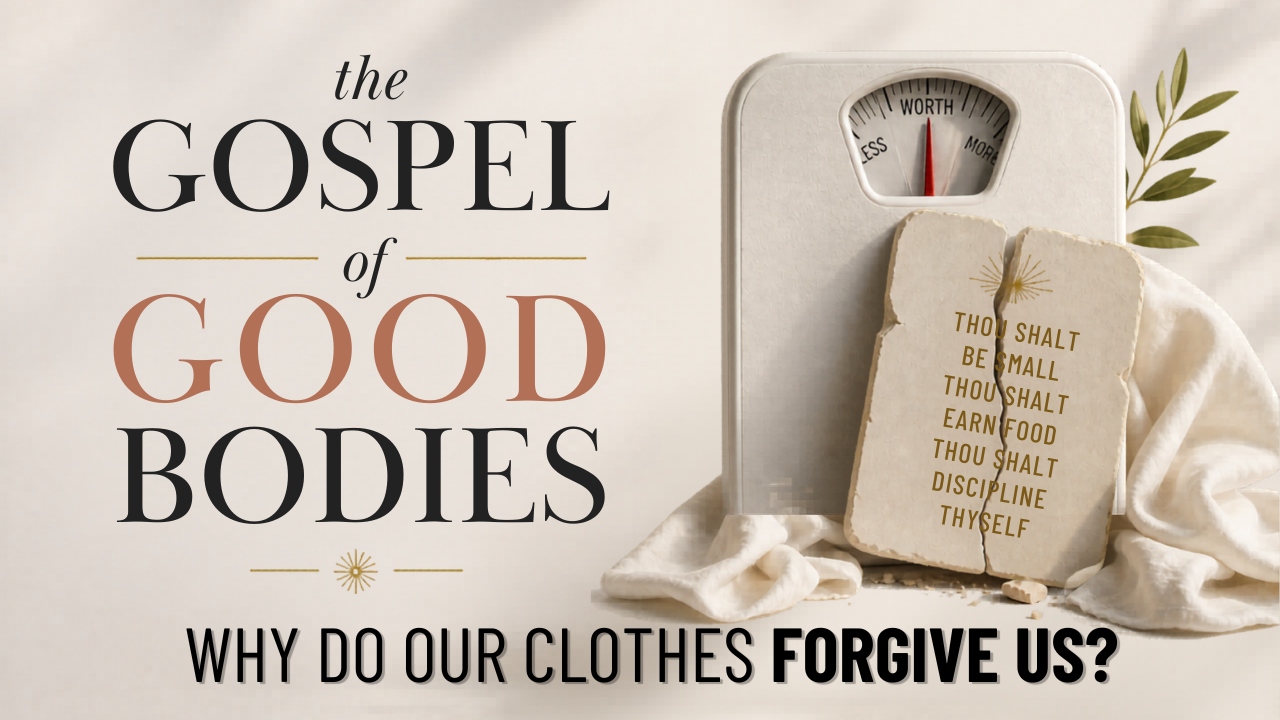
Title: Forgiving Clothes? The Gospel of Good Bodies and Combatting Body Shame by Exposing a Misuse of Religious Language
Podcast Date: May 19, 2026
Listen Here:
Description
Why do we want our clothes to be forgiving? In this thought-provoking episode, Heather Creekmore unpacks the deeper meaning behind the fashion world’s favorite words—like "forgiving" and "flattering"—and explores why so many of us feel pressure to make our bodies fit a narrow standard. Do our clothes really have the power to absolve us, or is there something bigger at play?
Join Heather Creekmore as she examines the surprising links between fashion lingo, theology, and our sense of self-worth. How does the language we use about our bodies sneak shame and judgment into our closets? What does it mean to break free from the idea of having "problem areas," and where can we look for true acceptance?
Whether you struggle with body image or have ever hesitated in the dressing room mirror, this episode will challenge what you believe about your body, your clothes, and what it truly means to be "good enough."
Tune in for powerful questions, real-life stories, and a fresh perspective that might change the way you get dressed tomorrow. Don’t miss it!
Ready to transform the way you think about food and your body? Join us for the next 40-Day Journey starting June 3rd. Learn more here.
Transcript
Disclaimer: This transcript is AI-generated and has not been edited for accuracy or clarity.
Heather Creekmore [00:00:02]:
Life Audio. Hey there. Heather Creekmore here. Thanks for listening to the Comparative podcast. Let's talk about the word forgiving. It's a word we use constantly around our clothes, isn't it? We want a forgiving waistband, forgiving silhouettes, forgiving fabrics. But forgiveness is a theological word, isn't presupposes an offense because that there's a judge and then there's an act of mercy. So what exactly have our bodies done wrong? Why do they need a certain kind of pants to find forgiveness? That's where we're going today.
Heather Creekmore [00:00:43]:
I'm glad you're here for it. We are in a series on essentially religious language that we use without even thinking about it in regards to our bodies and food. And we looked at diet plans and how they kind of mimic salvation stories and even, you know, what the church is supposed to do. We looked at what the Bible really says about food versus words we use around food, like I'm guilty for eating that and don't tempt me to eat that, those sorts of things. But today we're going to look at clothes. I mean, if you're anything like me, you've got a closet full of clothes and some of them fit ya and some of them don't. And it's kind of hard to think about getting rid of the ones that don't. And we do some funny things in our heads regarding clothing size and keeping clothes as kind of a maybe someday I'll be worthy of that again sort of mind game.
Heather Creekmore [00:01:47]:
But today we're going to talk about the forgiveness aspect. I'm glad you're here for it. Let's go. Forgiveness. We all need forgiveness, right? But here's some examples from fashion writing. Okay, this is a forgiving. A line skirt or this fabric is incredibly forgiving, which I'm guessing means it's like thick, so like rolls and lumps and stuff don't show through. I don't know.
Heather Creekmore [00:02:18]:
That's all I can figure out. Or how about this one? The wrap dress is universally flattering and endlessly forgiving. Wow. What a sweet dress to have to just endlessly forgive you for all your flaws and your sins. Okay, when did we start needing our clothes to forgive us? And what's the transgression? What's the offense? Note that the word is used without irony in virtually all fashion contexts. It has become so natural. Like, no one pauses over that word. But that's exactly what makes it worth pausing about.
Heather Creekmore [00:03:00]:
You see, the language of forgiving clothes is the end point of a long theological journey and it reveals that we have come to experience our bodies inherently offensive, requiring management, concealing, and ultimately forgiveness. And when human bodies require forgiveness, something has gone wrong with our anthropology. Have we forgotten that God called our bodies good and that we're made in his image? That's where we're going today. Let's start with this question. What's a body supposed to be? Right? Because implicit in the language of fashion is you need forgiveness, so there's something wrong, right? Forgiving implies that there's a standard from which you have deviated. So the first question is, what is the standard body that clothing is designed for, and why does deviation from it require forgiveness rather than just, say, different clothes? The fashion industry standard body is what you know, it's narrow, historically, very specific. It's achieved by a very small percentage of the population, some say less than 1%, and yet it functions as the norm. The very thin heroin chic from the 90s back to ozempic chic from the 2000 and 26es.
Heather Creekmore [00:04:42]:
The template from which all other bodies are variations is shown in front of us everywhere. But this is a theological move. It's the ideal has become the real and the actual has become the fallen. Flattering is the companion word to forgiving, right? Like, it's flattering on you. But think about that word, too. It's kind of equally strange. To flatter something is to make it appear better than it is, right? So if someone's flattering you, you know, they're kind of schmoozing you. They're saying.
Heather Creekmore [00:05:27]:
Saying nice things, maybe too nice. Like, if you ever watched a Leave it to Beaver back in the day there, it's Eddie Haskell, like, what a lovely dress you have on, Mrs. Cleaver. Like, it's going above and beyond to say things about you that aren't. They're a little overstated. So when we say a dress is flattering, we mean that maybe it makes the body appear closer to that standard from which we're all afraid we'll deviate. But again, flattering implies that the actual body, without the disguise of the flattering dress is insufficient. I quoted Robert Capone, an Episcopal priest who wrote a book back in the 90s called health, money and Love and why We Don't Enjoy Them.
Heather Creekmore [00:06:17]:
I quoted him a lot in our first episode in the series. But he pushes back against any anthropology that treats the body as a problem. And I think his points are good. I mean, his theology is incarnational. The body is the site of meaning. It's not an obstacle to meaning. And he talks about how food and pleasure that we're supposed to get from food weight, these are not enemies to be managed, but these are gifts to be received. The forgiving clothes frame is kind of anti incarnational, right? It, it says something different.
Heather Creekmore [00:07:00]:
It treats the actual body as an embarrassment that grace in the form of maybe elastic or draping must cover. And then we gotta draw a line to shame. Oh, body shame. I write about this in my 40 day body image workbook. Goodness. I think most of us rarely stop and think about the shame we feel around our bodies. Like we know we feel it. We know we have those constant voices in our heads telling us we should look better, do better.
Heather Creekmore [00:07:32]:
You know, we feel the pressure of the shame, we feel the embarrassment of the shame. But we don't often stop and say, oh wait, this is shame. We forget, you know, Romans 8:1, that there's no condemnation for those who love Christ Jesus, right? We listen to the condemnation, we accept the shame and think about it like this. I mean, a body that requires constant forgiveness is a body that we're experiencing as shameful. And shame, theologically is that experience of ourselves as unacceptable to the gaze of another. What gaze are we imagining when we dress ourselves? Who do we think is watching? Who do we believe is judging the way our bodies look? Now note in Genesis, right, The consequences of the fall. In Genesis 3, Adam and Eve notice that they are naked and they cover themselves, right? And so the experience of the body as exposed and insufficient, requiring covering is the oldest shame story, right? So, so forgiving clothes are in this reading thoroughly post fall kind of garments. If naked means ashamed, then we must cover our naked with things that will make us feel less shameful.
Heather Creekmore [00:08:53]:
But while we know scripture from scripture that Jesus's death and resurrection on the cross covers all of our shame. Like we are not trying to do that through clothes anymore. Like the work has been done, the fashion industry hasn't let it go. And there's a large theology grammar of body shame all through fashion. And we'll explore that more right after this quick break. So I'll never forget, I was like, I don't know, 26, 27 years old, single, and it was about to be my friend's wedding and so I'm with her at the bridal shop. I'm trying on bridesmaids dresses. I think I was the only local one.
Heather Creekmore [00:09:31]:
So I had the pleasure of trying on the bridesmaids dresses and being satisfied up as to whether or not those dresses would look good. On the other Bridesmaids as well. And I'll never forget the bride looking at me and saying, oh, I like that one. It covers your problem areas. Well, I wanted to run screaming out of that dressing room. Problem areas. The body has areas that are problems and problems require solutions and factors. Fashion provides solutions.
Heather Creekmore [00:10:09]:
And there is a therapeutic model with a religious structure. You have a diagnosis problem area. It was my thighs. You have a prescription. That dress, which I think had a wide skirt. And then management. Just continue to dress in such a way that your problem areas are hidden and then you will be free from shame and, I don't know, maybe guilt too. We also use words like hiding and minimizing, right? I think I bought a stomach minimizing swimsuit last summer.
Heather Creekmore [00:10:40]:
We speak of clothes that will hide body parts, minimize body parts, camouflage body parts. The body is something to be hidden, minimized, made less present. Unless it matches a certain standard, of course. But contrast this with showing off, which is reserved only for the parts of the body that conform to that standard. The ideal body is to be displayed while the deviant body is to be hidden. Then there's this whole language around work with your body versus work against your body. And this phrase is interesting because it implies that the body is an adversary. Your body is the enemy and you must negotiate with it.
Heather Creekmore [00:11:27]:
And fashion rules will tell you how to achieve a truce with your own flesh. Work with your body to have lines that elongate and make you look how? More like that standard. And then there's this concept of being universally flattering. Examine the logic here. A wrap dress is universally flattering because its design makes anybody look more like that standard. The standard is still the standard. The dress is just more effective at creating an illusion. Friend.
Heather Creekmore [00:12:03]:
This isn't about body acceptance. It's just sophisticated body management. So remember I quoted David Zahl in our first episode in this series. He wrote several great books. One of them is called Seculosity. But Zahl writes about the way performance anxiety migrates into appearance. When we can't achieve righteousness through behavior, we try to achieve it through the way we present ourselves. We try to look the part.
Heather Creekmore [00:12:36]:
Friend. This is us managing our image. Zahl says the fitting room becomes the confessional. The mirror becomes the judging gaze. The ideal outfit promises that today you will pass, you will be acceptable. And it's a promise that fashion, just like all law based systems, can't ultimately keep. Because there's always another season, there's always another standard, there's always another body part to address or fix or to make Conform to the standard. And, friend, I mean, let me just confess to you, like, I struggle here, too.
Heather Creekmore [00:13:19]:
I had to be up on stage with my husband last Sunday at church, and I had a really difficult time deciding what to wear. And I knew the right things to say to myself. I knew ultimately it was my words that were going to matter more than what I look like would matter. But, man, the judgment in our heads comes and the lies come. They won't listen to you unless you look a certain way. You know, they're going to judge you for the way you look. They're not going to like you. They're not going to accept.
Heather Creekmore [00:13:54]:
Accept you. I mean, even like cruel thoughts like women are going to think that you're not good enough for your husband, and they're going to try to cut in. I mean, the spirals can go anywhere and everywhere, friend. But ultimately, the underlying presupposition that I was accepting as I had my little stress out over what I was going to wear, is that my body is not a representation of me or good enough for me or good enough, period. Because it doesn't match the very narrow standard set by 1% of women that the fashion industry follows. And I just kind of bought right into that, like, I'm not good enough. I should not be anywhere close to a stage unless or until I am good enough. Right.
Heather Creekmore [00:14:44]:
And I don't know, you've probably had those thoughts, too. But I want us to notice here that looking the part isn't God's standard. That's the world's standard, or that's our own standard. Right, but that's not something he's asking of us. And is this language that we're using around our clothing keeping us stuck believing the lie that our bodies really aren't good enough? Our bodies really weren't made in the image of God. Our bodies really weren't called good by God. Our bodies really weren't given to us intentionally by God. Or maybe I really messed up my body because I did this thing with food or I did that thing with food, or I did this thing with exercise, or I have never exercised and I was supposed to look a certain way and be a certain way, and I let perimenopause get me, or I let pregnancy get me.
Heather Creekmore [00:15:37]:
And I failed with my body and I'm not doing well enough. And I should be. I should be. I should be. I should be. I should be. I should be. I should be like, friend, I felt it too.
Heather Creekmore [00:15:48]:
But I hope what you'll take from today is that 99% of us have bought in and are trying to match a standard that only applies to 1%. Okay? Now, we're in a zempic world right now, so maybe there's more than 1% that are getting it done. And we'll see what happens with that, right? I mean, it's yet to be proven whether or not they will stay that size or whether their bodies will rebel and ultimately want to be a bigger size again. We'll see. We'll see. But, friend, we don't have to live under that shame and condemnation anymore. We can do what God asks us to do in terms of making wise decisions, reasonably stewarding our body reasonably, without the obsession that would be required to meet culture standards. So let's go back to this concept of forgiving.
Heather Creekmore [00:16:49]:
And the question is, who is doing the forgiving? There's an invisible judge here. And there's also a promise of acceptance in Christianity, right? Forgiveness is very personal, right? It comes from God, right? And it requires a subject, right? Someone who is forgiving us. It is God forgiving us of the many ways that we have sinned against him. But who forgives you when you wear a waistband that's so tight it leaves a mark around your stomach? And the answer is unstated, but it's implied, right? Who forgives me is other people's eyes. Like, it's the social gaze, it's the judgment of others that I am free from and forgiven from. Or it's the internalized version of the judgment of myself. I am forgiven by me. Forgiving clothes make us acceptable to that gaze.
Heather Creekmore [00:17:57]:
They allow us to pass without penalty. But friend, in this, there's a profound loneliness. We don't need forgiveness from a gaze that is never actually looking at us that closely for an offense that, that we didn't actually commit through a mechanism. Clothing that can never actually forgive us of anything at all. Back to Robert Capone. He talks about the idea of grace and unconditional reception. You are received just as you are not as you manage to appear, right? We know from, from Samuel, God looks at the heart, not of the outside. The forgiving clothes framework inverts this completely.
Heather Creekmore [00:18:46]:
You must manage your appearance to be accepted. And that acceptance, oh, man, it's going to keep us so insecure because that acceptance is always conditional. It's always provisional. It always depends on wearing the right thing. That's a lot of pressure when you go in and out of the house, right? Am I going to be wearing something that is going to allow me to be accepted or am I going to wear something that risks rejection? And there's a psychological cost to this. The research on appearance based self evaluation shows that people who heavily base their self worth on their appearance have higher rates of depression, anxiety and disordered eating. This is the fruit of a law based anthropology. It produces guilt and never righteousness.
Heather Creekmore [00:19:42]:
And then there's the absurdity, which we've mentioned a couple times. But fabric can actually forgive you. An elastic waistband is not making a moral judgment and then withdrawing from it. The entire framework is a category error. We have attributed to cloth the function of grace. And in doing so we have revealed perhaps how desperately hungry we are for real grace. I wrote a book called the Comparison Free Life was originally titled the Burden of Better, but it's really a book about grace because I thought I knew what grace was like. You know, I'd sang Amazing Grace and you know, I knew I could define it for you, but I hadn't really experienced it.
Heather Creekmore [00:20:31]:
And I think my image issues and managing my body and managing my appearance and focusing on those things were outward examples of how much I struggled with grace. I did not deserve grace until I got my food and my body just right. And that is actually just antithetical to everything that grace is. Because grace is undeserved. And it's not based on me and what I do. It's based only on Jesus and what he did. I respond in obedience to him because he's offered that grace, but I'm not earning it myself. So if you've struggled with grace too, and really feeling God's grace as it applies to the way you look and your body and the story of your body, everything your body's been through, like, go grab my book, the Comparison Free Life, and it may encourage you as well.
Heather Creekmore [00:21:28]:
Okay, as we close here, what does it look like to have a different vocabulary? What would non religious fashion language actually sound like? I think it would be free of shame, right? We would be able to prioritize how our clothes feel rather than uber focusing on how they appear to others. We would be able to put on a pair of jeans that fit us and think, yay, I'm so glad they fit. I think they'll be comfortable. They're not cutting off my circulation. And we would be free from worrying about what the number is inside that size tag. And we would be out of our heads obsessing over I Can't Believe it's that number. I Can't Believe it's that number. I mean, friends, you know that there is no universal Sizing.
Heather Creekmore [00:22:22]:
What's A size 10 at one store is a size 2 at one store, and it's probably a size 22 on Amazon. You've been there. You know what I'm talking about, right? There's no universal sizing. And yet, and yet the shame and condemnation around our clothes, around fabric that can't forgive us, it's real. What would it look like to just think about clothes as a utility to serve our body versus thinking about how to change our body to serve clothes and maybe even ultimately to serve a fashion industry with a super narrow standard? Right. I think that's where we've gotten it confused. Back to David Zull. His book Seculosity ends with this concept of one way love.
Heather Creekmore [00:23:16]:
And that takes us right back to grace. It's grace that comes toward you without conditions. And the question for fashion and body image is, where does that kind of grace, that kind of warm welcome, that kind of reception, where does it come from? Friend, you're not going to get that from your mirror. Even if you look dang good in it, your mirror is not going to reply, oh, I love you so much more. Thank you. Thank you for doing that. Thank you for looking so good. You are my favorite.
Heather Creekmore [00:23:52]:
I love you. Your mirror is not going to say that. In fact, I would suggest the longer you stare in your mirror, the more your mirror is going to find something to point out. It could be like, yeah, you, you do. You look pretty good except for that spot on your face or except for the way your arms look in that. I mean, the mirror will find something wrong if you look in it long enough. And the same with the gaze of others, right? You're never gonna find the warmth, the grace, that one way love from having others look at you and approve, it's not gonna be enough. And they're fickle.
Heather Creekmore [00:24:28]:
They might approve one day and disapprove the next day, even if you're wearing something even better. It's so unstable and uncertain and it makes us so insecure. We cannot look to others for approval and still be serving Jesus. Right? Scripture tells us that explicitly Galatians 1:10. For am I now seeking the approval of man or of God, or am I trying to please man? If I were still trying to please man, I would not be a servant of Christ. Yikes. Friend, so hear me. This doesn't mean fashion is bad.
Heather Creekmore [00:25:13]:
Wanting to look nice is a pathological problem or a sin problem. That's not what I'm saying. But what I mean is that the words we use, the grammar we use is affecting us more than we know. And so what would it look like to swap words like forgiving for words like comfortable or roomy or, you know what? This feels good and fits well on my body without all the shameful language. And then what would it look like to accept God's grace and actually believe that God's opinion of me matters the most? Actually believe that God is looking at my heart and not my jean size. Actually believe that I am not standing in front of God every day waiting for him to tell me whether or not I look at him good enough or look acceptable, that that's not how he's looking at me. That's not how he's judging me. I am free to live for him and not to try to get everyone else's approval of my outfit of the day.
Heather Creekmore [00:26:25]:
Friend, that's a hard, hard thing to consider, but there's so much freedom there. So we spent the last three episodes talking about the ways our language reveals that there's deeper things going on when it comes to our food and our bodies and the way we eat and the plans we follow. And we started by talking about words like guilty pleasure and being bad in the first episode, and then we moved to talking about, like, the institutions and how they structure salvation for us, like Optavia or Gwen Shamblin's way down. And then today we talked about, really, the most intimate perhaps, of the way we think and speak about ourselves, like what happens with the mirror in the fitting room, and what are we actually believing about our bodies? And here's the through line. We have an inherent need for righteousness. We need to be right, acceptable, good enough. But in our secular age, we've relocated those needs into getting food right or getting the right size, acceptable body or getting an appearance that's good enough. They all promise the same thing, and they all fail to deliver.
Heather Creekmore [00:27:37]:
But what we all really long for, and I think why we all try to get it right, is we long for rest. We really don't want to worry about our food or our bodies or our appearance or our clothes anymore. Right? We just want to get to that place where we don't have to think about it anymore. And most of us have believed the biggest lie of diet culture is that once you do get to that thin body, then you're free. Then you don't have to think about it anymore. You've arrived. That's heaven. Because you've earned your rest.
Heather Creekmore [00:28:10]:
Oh, friend, I've said this a hundred times on the show. Anyone who has a before and after picture knows that you don't actually achieve rest then. In fact, studies show that most women who lose a significant amount of weight actually become more obsessed with body image. They have a bigger problem around body image after the weight loss. That's one of the big concerns around the GLP1's Ozempic craze right now is that there's higher rates of suicide associated. And whether or not it's actually something the GLP1 is doing to your system, I'm not sure. But a interesting theory is that you've waited your whole life to have a smaller body and believe that having a smaller body will give you that rest, that freedom to just not think about your body and food and clothes anymore. And you think you've arrived and you haven't.
Heather Creekmore [00:29:07]:
And for some, especially those without the hope of Jesus, it's so discouraging. It's such a letdown. It's such a tragic revelation when you find that everything you hoped and dreamed it would be was not connected to having a thinner body. May you actually have thoughts of ending it all because you don't have any hope anymore. That's what your hope was in. And friend, that's why I just don't want us to lose sight of what our true hope is. Where our real salvation is. It's not in Optavia working.
Heather Creekmore [00:29:44]:
It's not in clean eating making us pure. It's not in finding the right outfit so we're acceptable for everyone else's gaze. Friend, our real hope is in Christ alone. Period. End of sentence. And through his grace, we can wrestle through these issues we have with our bodies, these issues we have with food, these issues we have with clothing. We can wrestle through them without shame and condemnation, without fear of not being accepted or loved because we know we are already accepted and loved in him and what other people think. It really doesn't have to matter that much.
Heather Creekmore [00:30:27]:
Oh friend, there's so much hope. But it's in the cross of Jesus Christ and real forgiveness, real sanctification, real reconciliation, real restoration from our sinful fallen state. Don't be confused. Hey, thanks for listening today. I hope you've enjoyed the series. If you have, drop us a review on wherever you get your podcast. Really, those reviews help other people find the show? The amount of reviews I have is really crazy small compared to how many listeners there are. And so maybe if you're one of those people who hasn't left a review yet, would you just consider doing that? Greatly appreciate your consideration there.
Heather Creekmore [00:31:11]:
Coming up next time with an interesting episode on how the Oura Ring versus the Apple Watch gives us a picture of how God treats us around food and body versus how we treat ourselves. I hope you'll tune in for that one. And if this series has been of interest to you, maybe it'd be interest of interest to a friend. So consider sharing it. Hey, thanks for listening. I hope something today has helped you stop comparing and start living. Bye. Bye.
Tired of fighting your body image issues alone? Do you know that you're "fearfully and wonderfully made," yet still feel like your body isn't good enough?
Sign up here for weekly encouragement and take the 5-Day Body Image Challenge!